Montana
Montana Transfer on Death Deed: The One-Year Problem Nobody Mentions
By Daniel Bear · Montana · October 7, 2026
By Daniel Bear, founder of TitleQuest Pro. In real estate since 2016, based in Bozeman, buying inherited Montana property and paying for the curative title work himself.
Your mom did everything right. She went to a lawyer, signed a Montana transfer on death deed naming you, and recorded it at the courthouse so the house would skip probate. Then she passed, and you listed the place, and a buyer made an offer. Now the title company is saying something you did not expect: they cannot insure your sale cleanly until a year after her death.
Nobody told you about the year.
This post explains where that year comes from, why it stops a financed buyer cold, and the four ways families actually get through it. I buy inherited Montana property for a living and I see this exact wall every month, so I am going to be blunt about what works.
Quick answer: A Montana transfer on death deed passes real property to a named beneficiary at death without probate, but under MCA 72-6-112 the deceased owner's creditors can still reach that property for one year after the death. Title insurers write that risk as an exception and lenders will not fund a purchase against it, so a beneficiary usually cannot sell to a financed buyer inside that first year.
What a Montana transfer on death deed actually does
Montana adopted the Uniform Real Property Transfer on Death Act in 2019. It lives at Title 72, chapter 6, part 4 of the Montana Code Annotated, which is the state's book of statutes. A few plain-English rules come out of it.
The deed has to be recorded before the owner dies, with the clerk and recorder in the county where the land sits. That is MCA 72-6-408. A signed deed found in a desk drawer after the funeral does nothing.
The deed is revocable. The owner can change the beneficiary or cancel the deed at any time by recording a new instrument. It has no effect while the owner is alive, and the beneficiary has no rights until the death. The statute calls it nontestamentary, which means it works outside the will and outside probate.
At death, the beneficiary takes the property subject to everything already attached to it. MCA 72-6-412 says that in so many words: mortgages, liens, easements, delinquent taxes, all of it rides along. The deed moves ownership. It does not clean anything.
What this means for you: a Montana transfer on death deed is a delivery mechanism, not a title cure. Whatever was wrong with the property the day before the death is still wrong the day after. And one new problem shows up that was not there before.
The one-year problem
Here is the part the estate-planning brochures skip.
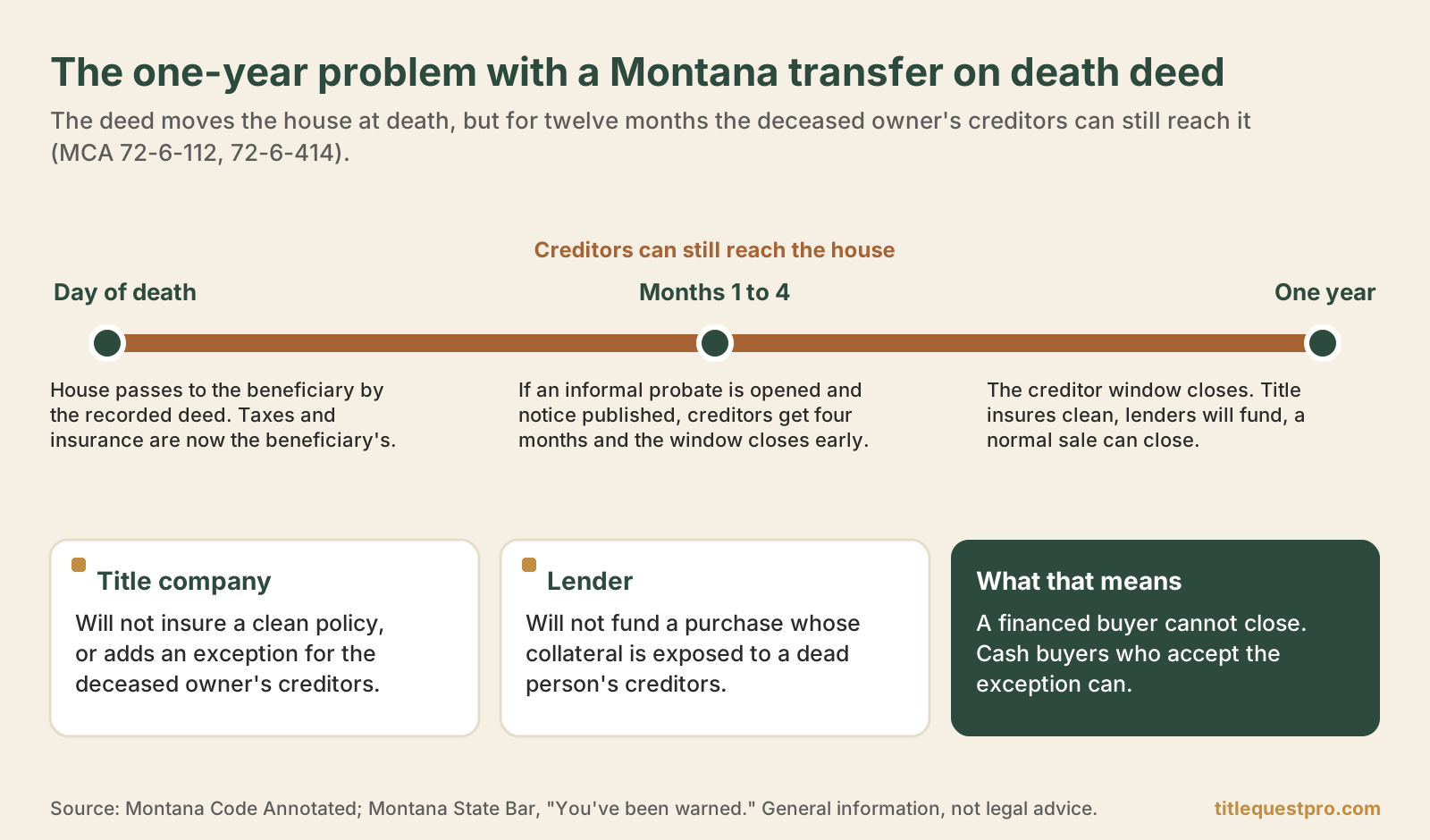
When someone dies in Montana, the people they owed money to have a window to get paid from the estate. If a formal probate is opened and the personal representative publishes notice, creditors get four months to file claims, under MCA 72-3-801. If nobody opens a probate, the outside limit is one year from the date of death, under MCA 72-3-803.
A Montana transfer on death deed skips probate. So nobody publishes notice, and nobody starts the four-month clock. That leaves the one-year clock.
MCA 72-6-414 says a transfer on death beneficiary is liable for allowed claims against the estate to the extent the probate estate cannot pay them, capped at the value of what the beneficiary received. And MCA 72-6-112(8) says any proceeding to collect from a nonprobate transfer "must be commenced within 1 year after the decedent's death."
Read those two sentences together and you have the problem. For a full year after the death, the house you now own by deed can still be pulled back toward your parent's debts.
A hospital bill, a credit card balance, a contractor who was never paid, Medicaid estate recovery. Any of them could file within the year.
Why the title company will not insure it
Title insurance is a promise that the buyer owns the property free of surprises. During the year, there is a surprise sitting right there in the statute. So the title company does one of two things: it refuses to insure until the year has run, or it insures with an exception that says, in effect, "except for claims by the creditors of the person who died."
The Montana State Bar published a warning about exactly this, in an article titled "You've been warned: Lurking issues remain with transfer on death deeds." The authors, two Montana practitioners, wrote that title companies will not insure a beneficiary's title without that exception until either a probate has been opened and the creditor period has run, or a year has passed since the death.
Why the lender walks away
A bank lending on a house wants first-position collateral with no cloud over it. An exception for a dead person's unknown creditors is a cloud. The same State Bar article says it plainly: banks will not finance a purchase where their collateral is subject to a decedent's creditors.
So the buyer who offered you full price with a 30-year mortgage cannot close. Not because anything is wrong with your deed. Because the statute leaves the door cracked for twelve months and the lender will not walk through it.
What this means for you: the problem is not that you cannot sell. The problem is that you cannot sell to anyone who needs a bank, for a year. That narrows your options to four.
The four doors: how beneficiaries get through the year
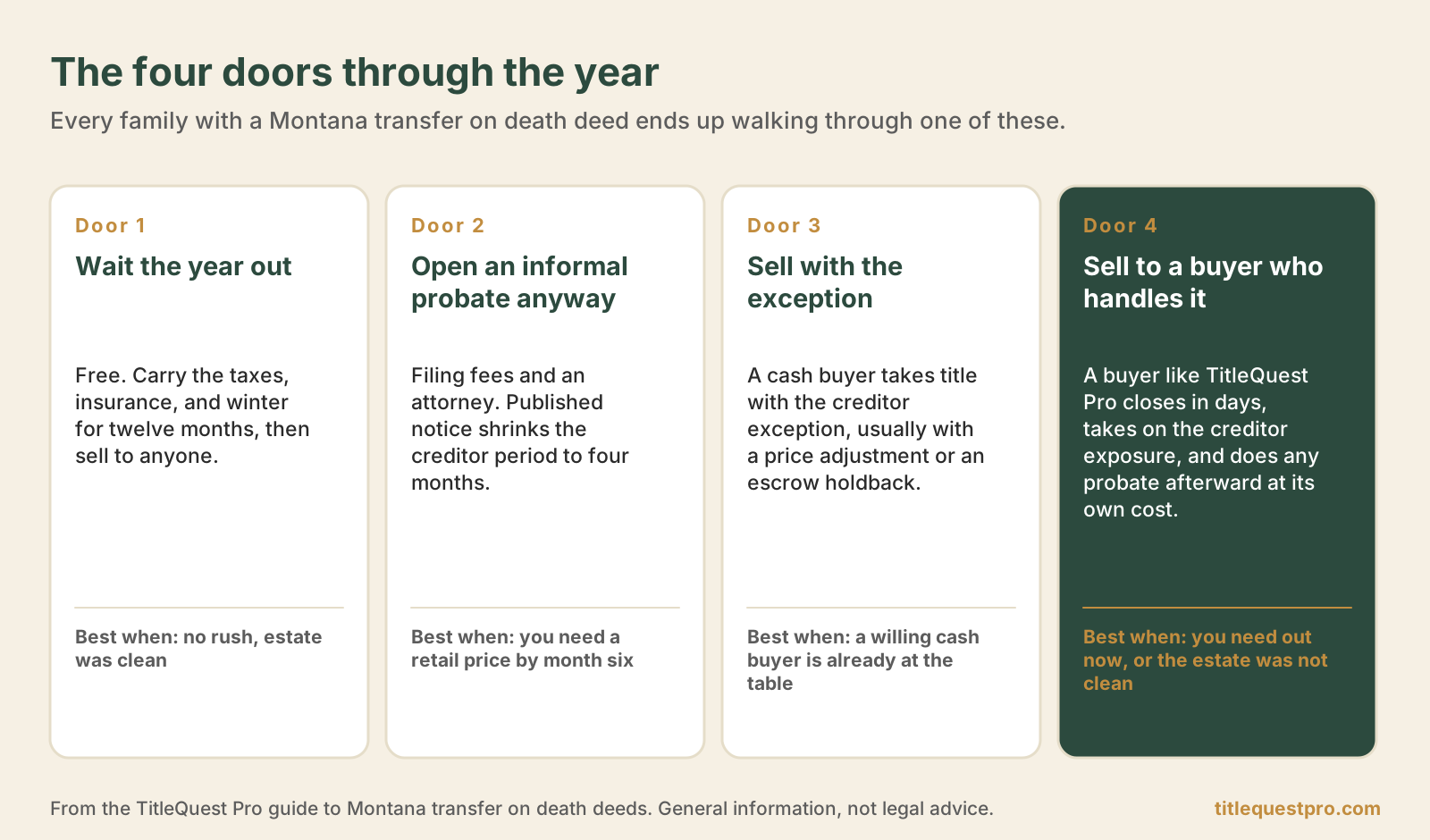
I think of this as the four-door problem, because every family I talk to ends up walking through one of these. Which one fits depends on how fast you need to sell, what the estate owed, and how much the house is costing you to hold.
Door one: wait the year out
The simplest option. Record the affidavit of death, keep paying the taxes and insurance, and list the house after the first anniversary. Once a year has passed, the one-year bar in 72-6-112(8) has run, the exception comes off, and a financed buyer can close like any other sale.
The cost is carrying the property. Property taxes keep accruing, and Montana's are due in two halves, November 30 and May 31. Insurance on a vacant house is expensive and some carriers will not write it. Winter in Montana finds the pipes.
If you live out of state, somebody has to check on the place. Twelve months of that adds up, and if the taxes were already behind when your parent died, you are now racing a second clock, which I cover in the post on a Montana tax lien on an inherited property.
Door two: open an informal probate anyway
This sounds backwards, since the whole point of the deed was to avoid probate. But an informal probate in Montana is handled by the clerk of district court without a hearing, and once a personal representative is appointed and publishes notice to creditors, the claim period shrinks from a year to four months under 72-3-801.
Title companies generally accept that. Four months of published notice with no claims filed is the evidence they want. So a family that needs to sell in month six, not month thirteen, sometimes opens a small informal probate for the sole purpose of starting the four-month clock. It costs filing fees and usually an attorney, and it means the thing the deed was supposed to prevent happens anyway.
If you go this route, understand how the process works first. The full picture of informal versus formal probate in Montana, including timelines, is in its own post, and so is what a Montana personal representative can do with the house once appointed.
Door three: sell with the exception to a buyer who accepts it
A cash buyer does not need a lender's approval. Some cash buyers will close during the year and take title with the creditor exception on the policy, usually with a price adjustment for the risk, or with part of the proceeds held in escrow until the anniversary passes.
This is a real door, but a narrow one. Most retail buyers, even cash ones, want a clean policy. The buyers who will take an exception are investors who understand the statute and have priced it. That brings me to door four.
Door four: sell to a buyer who handles the problem
This is what TitleQuest Pro does, so read this section knowing I have an interest in it.
We buy inherited Montana property for cash, we close during the year, and we take on the creditor exposure ourselves. Before we make an offer, our team pulls the deed, checks the tax history, and researches what the estate might owe, so we know what we are stepping into.
After closing, the curative work and its cost are ours, not yours. If that means opening a probate to clear the four-month period, we do it after you have been paid, not before.
The trade is straightforward. You get certainty and a closing date measured in days. We get a property we have to carry and clean up. The price reflects that, and I will tell you plainly in the written offer what it reflects.
What this means for you: if waiting a year is fine, door one is free. If you need to sell sooner and the estate was clean, door two is the cheapest path to a retail price. If you need out now, or the estate was not clean, door four is the one that actually closes.
What to record after the death
The statute does not require any particular post-death filing, which surprises people. In practice, the clerk and recorder and the title company want two things.
First, an affidavit of death. This is a short notarized statement, usually prepared by the beneficiary or an attorney, saying the owner died on a certain date and attaching a certified copy of the death certificate. It gets recorded against the property so the public record shows the transfer has happened. MSU Extension's guide on the Montana transfer on death deed, MontGuide MT202010HR, walks through this.
Second, a Montana Realty Transfer Certificate, which is Department of Revenue Form 488. Montana requires one whenever real property changes hands, including by a transfer on death deed, so the county can update the tax roll.
Record both and the property is in your name for every purpose except the one-year creditor window. The taxes are now your bill. If the first half was due November 30 and nobody paid it, the county treasurer is already counting.
Five ways a Montana transfer on death deed goes wrong
I see these over and over. None of them is the beneficiary's fault, and all of them are fixable, but each one takes a different tool.
The deed was signed but never recorded
If the deed was not recorded before the death, it is not a Montana transfer on death deed. It is a piece of paper. The property is part of the probate estate and passes under the will, or if there is no will, under the Montana inheritance laws for people who die without one. That means probate, informal at minimum, before the house can be sold.
The beneficiary died first
A beneficiary who does not survive the owner takes nothing. If the deed named only that one person and no alternate, the deed lapses and the house goes back into the probate estate.
There is a mortgage
The deed does not pay off the loan. Federal law generally lets a relative who inherits and moves into the home keep the existing mortgage, but the payments are now yours, and a lender who sees the house sitting vacant and the payments stopping will start a foreclosure that does not care about the one-year window.
Several beneficiaries, one house
If the deed names three siblings, all three own the house together the day after the death. Nobody can sell the whole thing without the other two signing. One sibling can sell their own share, though, and that is a path families use when they cannot agree. We buy partial interests in inherited Montana property for exactly that reason.
Someone tries to use a small estate affidavit on it
A Montana small estate affidavit reaches bank accounts, vehicles, and personal property up to $100,000. It does not reach real estate at all, so it cannot fix a lapsed or missing Montana transfer on death deed. I wrote a separate post on what the Montana small estate affidavit does and does not do, because the confusion costs families months.
Where TitleQuest Pro fits
Most of the families I talk to about a Montana transfer on death deed are not looking for the highest price. They are looking for a way out of a house that is costing them money in a state they may not live in, with a title company telling them to wait a year.
Here is how we work. You tell us about the property, which takes about five minutes on the form below or on a call. Our team reviews the title, the tax history, and what the estate might owe, which takes one to seven days and costs you nothing. We send a written cash offer within 48 hours of that review, with the price and closing laid out in email, no verbal numbers.
You decide. If it is a yes, we close within days, you sign remotely with a notary, and we pay the closing costs and the curative work. There is one more thing our team checks before every Montana offer that most buyers skip, and it is usually the thing that makes or breaks the deal. I will walk you through it on the call.
The offer has no deadline and no pressure. If waiting the year is your best move, I will say so.
Tell us about the property or call (406) 920-1095.
Questions I hear about Montana transfer on death deeds
Yes, for the property named in the deed. If the deed was properly signed and recorded before the owner's death, the property passes to the beneficiary at death without a probate proceeding. The rest of the estate may still need probate, and the beneficiary remains exposed to the deceased owner's creditors for one year after the death under MCA 72-6-112.
You can sign a contract, but most title companies will not issue a clean policy until one year after the death, and lenders will not fund a purchase with a creditor exception on the title. That leaves cash buyers who accept the exception, or opening an informal probate to run the shorter four-month creditor period.
Under MCA 72-6-112(8), any proceeding by the deceased owner's creditors to reach property that passed outside probate must be started within one year of the death. During that year, the beneficiary's title is subject to those claims up to the value received, which is why title insurers add an exception and buyers with financing cannot close.
Yes. The deed must be signed with the same formalities as any Montana deed, including notarization, and it must be recorded with the clerk and recorder of the county where the property is located before the owner dies. MCA 72-6-408 makes recording before death a requirement, not a formality. An unrecorded deed transfers nothing.
The beneficiary must survive the owner to take the property. If the only named beneficiary has already died and the deed names no alternate, the transfer fails and the property becomes part of the owner's probate estate, passing under the will or, with no will, under Montana's intestate succession rules.
Yes, but the beneficiary takes the property subject to both. MCA 72-6-412 says the beneficiary receives the property with every mortgage, lien, and encumbrance that existed at death. The loan payments and the property taxes become the beneficiary's responsibility immediately, and a Montana tax lien attaches on schedule regardless of the death.
The bottom line
A Montana transfer on death deed does what it promises: it moves the house without probate. What it does not do is make the house sellable to an ordinary buyer the day after the funeral. The statute leaves creditors a one-year window, title insurers respect that window, and lenders will not lend across it.
You have four doors. Wait the year, open a small probate to shorten it, sell with the exception to a buyer who accepts it, or sell to a buyer who takes the whole problem off your hands. Pick based on how long you can carry the house and what the estate owed, not on what the brochure said.
TitleQuest Pro is not a law firm. This is general information drawn from the Montana Code Annotated, the Montana State Bar, and MSU Extension, not legal advice. Statutes change and every estate is different, so confirm your situation with a Montana attorney or your title company.
If the property is stuck and you want a number, tell us about it. I read every message myself.

Daniel Bear
Founder, TitleQuest Pro
Daniel has been in real estate since 2016 and today buys inherited houses and untangles the titles other buyers won't touch. He works from Bozeman, Montana, with one foot in Montana and the other on the ground in Texas. TitleQuest Pro is not a law firm; this is general information, not legal advice.
Related reading.
Sell your share of inherited property
Sell your fractional interest without convincing the rest of the family.
Sell your share of inherited property →Sell a house with a tax lien
We close on Texas houses with active tax suits.
Sell a house with a tax lien →Clear title on inherited property
How to clear clouded title on inherited Texas property.
Clear title on inherited property →Ready when you are.
When you're ready to talk, we're here. Fill out the form, give us a call, or book a 15-minute conversation with Daniel. We'll handle the next step.
Tell us about the property.
We'll review it. We'll call you back within 24 hours. No pressure, no fees, no obligation.