Montana
Montana Tax Lien on an Inherited Property: The 3-Year Clock Explained
By Daniel Bear · Montana · October 7, 2026

By Daniel Bear, founder of TitleQuest Pro. In real estate since 2016, based in Bozeman, buying inherited Montana property and paying for the curative title work himself.
The envelope is from the county treasurer and it is addressed to your father, who died two years ago. Inside is a notice that a Montana tax lien has been assigned to a company you have never heard of, that interest is accruing, and that if the taxes are not paid by a date in August the property may be deeded away. You did not know the taxes were behind. Nobody did. The mail went to a house no one lives in.
I have read that letter with a lot of Montana families. Here is what it means, how much time you actually have, and what to do with it.
Quick answer: A Montana tax lien attaches to a property with delinquent taxes no later than the first working day in August, under MCA 15-17-125. The owner or heirs can redeem by paying the taxes, penalties, interest, and costs any time until the first working day in August three years later. If nobody redeems, the lien holder can take a tax deed, and on an occupied home the county auctions it instead.
How a Montana tax lien happens: the calendar
Montana property taxes come due in two halves. The first half is due November 30, or 30 days after the tax notice was mailed if that is later. The second half is due May 31. Miss either deadline and the half is delinquent the next day, with a 2 percent penalty and interest at five-sixths of one percent a month, which works out to ten percent a year.
That is MCA 15-16-102.
Then the county treasurer's calendar takes over.
On or before the last Monday in June, the treasurer publishes or posts a list of properties with delinquent taxes and a notice that a tax lien is coming. MCA 15-17-122.
At least two weeks before the lien attaches, the treasurer mails a notice to the assessed owner, at the address on the tax roll. On an inherited property that is usually the deceased owner, at the empty house.
No later than the first working day in August, the treasurer attaches the tax lien. MCA 15-17-125. From this day the three-year redemption clock is running.
What this means for you: a Montana tax lien is not a lawsuit and nobody has to sue anyone. It is a calendar. One missed May 31 becomes an August lien with no further warning that reaches a family who is not watching the mail.
The three Augusts: how long you have
I describe the Montana tax lien timeline as three Augusts, because the whole thing is anchored to that month.
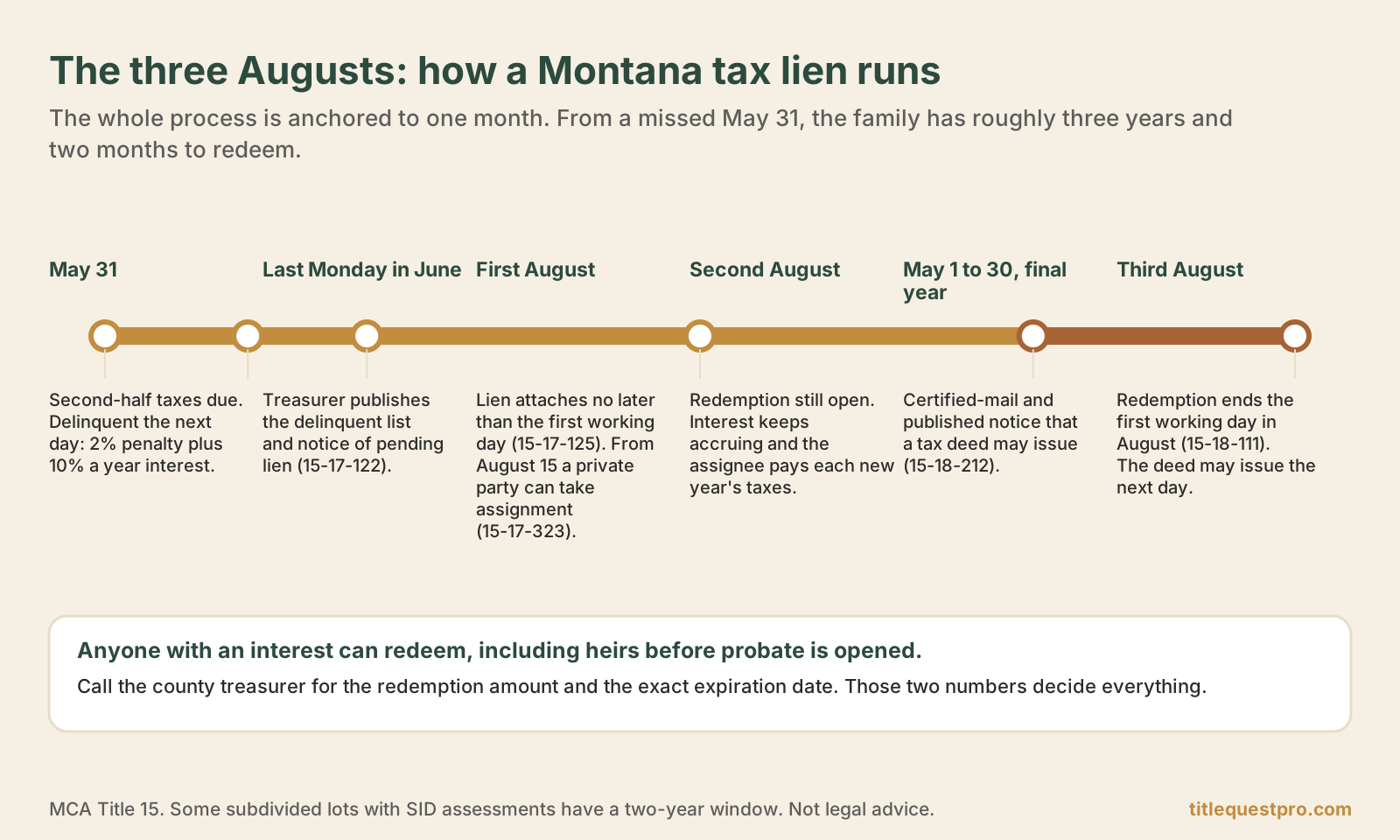
First August: the lien attaches. The county holds it. Starting August 15, any person can take an assignment of the lien from the county by paying every dollar of delinquent tax, penalty, interest, and cost on the property. MCA 15-17-323. Before they pay, they have to send the assessed owner a certified-mail notice at least two weeks ahead.
Second August, third August: redemption runs. Under MCA 15-18-111, the property can be redeemed until the first working day in August three years after the lien attached. Pay the treasurer the full amount, including the ten percent interest the assignee has been earning, and the lien is released. There is a shorter two-year window for subdivided lots with delinquent special improvement district assessments and no habitable structure, which mostly means vacant lots in platted subdivisions.
May before the fourth August: the final notice. Between May 1 and May 30 of the year the redemption period expires, the lien holder sends a notice by certified mail to the occupant and every interested party of record, and publishes it, saying that a tax deed may issue. MCA 15-18-212. The deed can issue the day after the redemption period ends.
So the realistic answer to "how long do I have" is: from the first missed deadline, roughly three years and two months until the last day to redeem, and you will get one certified letter in May of the final year telling you so.
What this means for you: the clock is long, which is why families lose track of it. By the time the May letter arrives, the lien has been accruing interest for almost three years and the payoff is far larger than the original tax bill.
What a tax lien assignment actually means
The notice that frightens families most is the one saying the lien was assigned.
An assignment means a private party, often an investment company, paid your property's delinquent taxes to the county and now holds the lien. They are not the owner. They cannot evict anyone, enter the property, or demand payment from you directly. What they have is a claim secured by the property, earning ten percent a year, and the right to apply for a tax deed if nobody redeems before the third August.
The holder of a Montana tax lien also has to keep paying. Each year's new taxes that go unpaid get added to the lien, and the assignee usually pays them to protect their position. That is why the payoff grows every year.
What this means for you: an assigned lien is a countdown with a stranger holding the stopwatch. Nothing has been taken yet. But the person holding the lien is waiting for the deadline, not for you.
How to redeem a Montana tax lien
Redeeming a Montana tax lien is simple in mechanics and hard in cash.
Call the county treasurer in the county where the property sits and ask for the redemption amount. It is one number: all delinquent taxes, penalties, interest, and costs, including any later years the assignee paid. Gallatin, Yellowstone, Missoula, and most larger counties will quote it the same day.
Anyone with an interest in the property can redeem, and that includes heirs of a deceased owner even before probate is opened. The treasurer does not require you to prove you own it; they require the money.
Pay it, and the treasurer issues a redemption certificate and the lien is released of record. The clock resets to zero and the next year's taxes are due on the normal schedule.
If the amount is more than you can raise, the question is not how to redeem. It is whether to sell before the third August while the equity is still yours.
What happens if nobody redeems
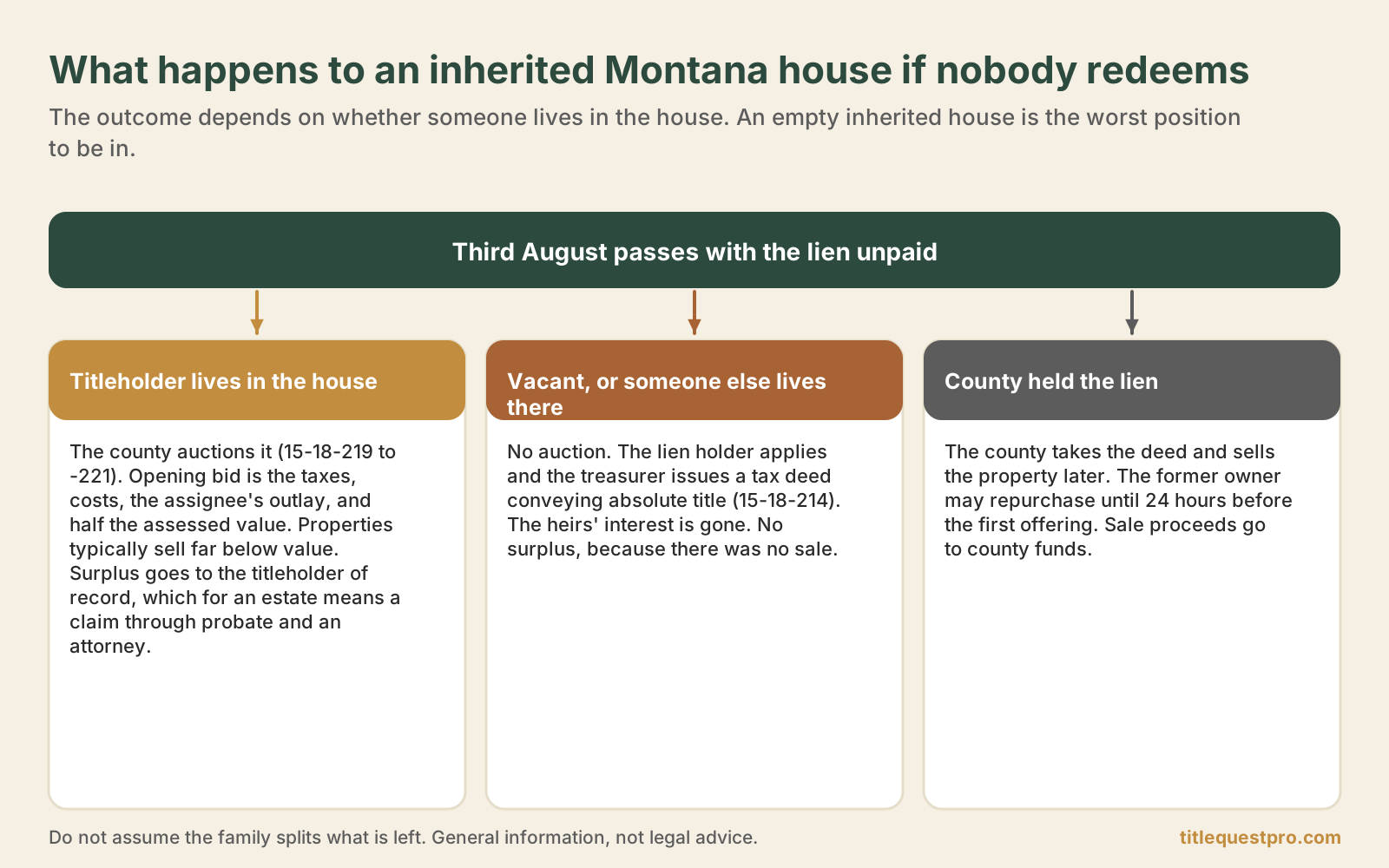
This is where Montana law splits by what kind of property it is, and the difference matters enormously to a family.
Occupied home: the county auctions it
If the property has a dwelling that the titleholder occupies, the assignee cannot simply take a deed. Under MCA 15-18-219 through 15-18-221, the treasurer auctions the property within 60 days of the application. The opening bid is the delinquent taxes, penalties, costs, the assignee's outlay and fees, plus half the assessed value of the land and the dwelling. The owner can still redeem right up to the auction.
Properties at these auctions typically sell for far below what they would bring in an ordinary sale. The opening bid is built on half the assessed value, and the buyers are investors pricing in risk. Any surplus above what is owed goes to the legal titleholder of record within 30 days. On an inherited property where the title is still in a deceased person's name, that means the estate has to claim it, which usually means a probate and an attorney, not a check in the mail.
Do not assume the family simply splits what is left.
Vacant land or a house nobody lives in: the deed goes to the lien holder
If the property is vacant land, or a house that is not occupied by the titleholder, there is no auction. After the May notice and the final August, the assignee applies and the treasurer issues a tax deed. MCA 15-18-214 says that deed conveys "absolute title" as of its date, subject only to later taxes, assessments, easements, and covenants. The former owner's interest, and the heirs' interest, is gone.
There is no surplus because there was no sale.
This is the case that hurts inherited property most. A parent's house in Butte that the kids in Seattle have not visited in three years is, by definition, not occupied by the titleholder.
County-held liens: the county sells it
If no private party took the lien, the county itself takes the tax deed and later sells the property under MCA 7-8-2301 through 7-8-2307. The former owner has a right to repurchase for the taxes, interest, and costs until 24 hours before the first offering. After that the sale proceeds go to county funds, and the statute provides no surplus to the former owner.
What this means for you: the outcome depends on whether someone is living in the house. An empty inherited house is the worst position to be in when the third August arrives, because there is no auction, no surplus, and no second chance.
Why inherited property is so exposed to a Montana tax lien
Every step of the Montana tax lien process assumes the owner is reading their mail. On an inherited property, the owner is dead and the mail goes to the house.
The heirs often do not know the taxes exist until the assignment notice. The estate may not have been opened, so nobody has authority to act and nobody is clearly responsible. If a transfer on death deed moved the house to a beneficiary, that beneficiary now owes the taxes and may not know it; the deed does not pay them, and I explain the rest of that situation in the post on the Montana transfer on death deed. If a probate is open, the personal representative is the one who should be paying, and letting the taxes go delinquent is one of the three mistakes I warn about in the post on what a Montana personal representative can do with the house.
And if your parent died without a will, the heirs who own the property are set by the Montana inheritance laws, which may include relatives nobody has told. Each of them has an interest. Each of them is losing it on the same August day.
Four moves if the property you inherited is behind
When a family calls me holding the treasurer's letter, I walk them through four moves, in this order.
Move 1: get the exact number and the exact date
Call the treasurer. Ask for the redemption amount as of today and the date the redemption period expires. Write both down. Everything else depends on them.
Move 2: find out who holds the lien
Ask whether the lien has been assigned, and to whom. An assigned lien means a private party is waiting for the deadline. A county-held lien means there is more flexibility, and sometimes a payment plan, before anyone applies for a deed.
Move 3: decide whether the family can carry it
Redemption is one number today, and it grows ten percent a year plus each new year's taxes. If the family can pay it and wants to keep the house, pay it now, not in the final August. If the family can pay it but does not want the house, pay it and sell on the open market, because a property with a released lien and clear title brings a better price.
Move 4: if you cannot carry it, sell before the third August
A house with a tax lien and years of redemption still ahead has equity. A house the day after the tax deed issues has none. If the family cannot redeem, the window to sell is now, while the lien is a payoff at closing rather than a loss.
Where TitleQuest Pro fits
A lot of the Montana families I talk to found out about the taxes from the assignment letter. The house has been empty for a couple of years, the estate was never opened, the siblings do not agree, and there is a date in August coming that nobody can afford.
We buy inherited Montana property with a Montana tax lien on it, and we pay the lien off at closing out of the purchase price.
Here is how it works. You tell us about the property, which takes about five minutes on the form or a call. Our team pulls the deed, the tax history, the redemption amount, and the chain of title, and maps the heirs. That takes one to seven days and is not billed.
We send a written cash offer within 48 hours of the review, with the price, the tax payoff, and the closing laid out in email. You decide. If it is a yes, we close within days, you sign remotely with a notary, the treasurer gets paid from the proceeds, and we handle any probate or curative work after closing at our cost. There is one more thing our team checks before every Montana offer that most buyers skip, and it is usually the thing that makes or breaks the deal. I will walk you through it on the call.
If the family can redeem and should, I will say so. The offer has no deadline. The treasurer's does.
Tell us about the property or call (406) 920-1095.
Questions I hear about a Montana tax lien
Three years. Under MCA 15-18-111, a property can be redeemed until the first working day in August three years after the tax lien attached. The exception is subdivided lots with delinquent special improvement district assessments and no habitable structure, which have a two-year redemption period. Redemption requires paying all delinquent taxes, penalties, interest, and costs.
No later than the first working day in August of the year after taxes went delinquent, under MCA 15-17-125. The treasurer publishes a list of delinquent properties on or before the last Monday in June and mails notice to the assessed owner at least two weeks before attaching the lien.
Yes. Anyone with an interest in the property can redeem by paying the treasurer the full redemption amount, and heirs qualify even if probate has not been opened. The treasurer does not require proof of ownership to accept a redemption payment. The lien is released of record once paid.
A private party paid the delinquent taxes, penalties, interest, and costs to the county and took over the lien under MCA 15-17-323. The assignee earns interest at ten percent a year, usually pays later years' taxes to protect the lien, and may apply for a tax deed after the three-year redemption period if the property is not redeemed. The assignee is not the owner.
If the titleholder occupies the house, the county auctions it under MCA 15-18-219 and any surplus goes to the titleholder of record, which for an estate means a claim through probate. If the house is vacant or occupied by someone other than the titleholder, the lien holder receives a tax deed conveying absolute title, with no auction and no surplus to the family.
Yes. Under MCA 15-16-102, each delinquent half is charged a 2 percent penalty plus interest at five-sixths of one percent per month, which is ten percent a year, from the day after the due date. Montana's due dates are November 30 for the first half, or 30 days after the notice is mailed if later, and May 31 for the second half.
The bottom line
A Montana tax lien is a calendar, not a lawsuit. The lien attaches in August, a private party can buy it two weeks later, and the family has until the third August after that to pay it off. Then the house goes to auction if someone lives in it, or straight to the lien holder by deed if nobody does.
Inherited property loses on that calendar more than any other kind, because the notices go to someone who cannot read them. Get the number, get the date, find out who holds the Montana tax lien, and decide whether to redeem or sell while the equity is still the family's.
TitleQuest Pro is not a law firm. This is general information drawn from the Montana Code Annotated, not legal advice. Statutes and county procedures change, so confirm your situation with the county treasurer and a Montana attorney.
If the August date is closer than the family's money, tell us about the property. I read every message myself.

Daniel Bear
Founder, TitleQuest Pro
Daniel has been in real estate since 2016 and today buys inherited houses and untangles the titles other buyers won't touch. He works from Bozeman, Montana, with one foot in Montana and the other on the ground in Texas. TitleQuest Pro is not a law firm; this is general information, not legal advice.
Related reading.
Sell your share of inherited property
Sell your fractional interest without convincing the rest of the family.
Sell your share of inherited property →Sell a house with a tax lien
We close on Texas houses with active tax suits.
Sell a house with a tax lien →Clear title on inherited property
How to clear clouded title on inherited Texas property.
Clear title on inherited property →Ready when you are.
When you're ready to talk, we're here. Fill out the form, give us a call, or book a 15-minute conversation with Daniel. We'll handle the next step.
Tell us about the property.
We'll review it. We'll call you back within 24 hours. No pressure, no fees, no obligation.