Montana
Montana Inheritance Laws: Who Gets the House When There Is No Will
By Daniel Bear · Montana · October 7, 2026
By Daniel Bear, founder of TitleQuest Pro. In real estate since 2016, based in Bozeman, buying inherited Montana property and paying for the curative title work himself.
Your dad died in March. There was no will, or there was one once and nobody can find it. The house in Helena is still in his name, the tax bill is still coming to his mailbox, and three siblings in three states are asking the same question in three different tones: who owns it now?
Montana inheritance laws answer that question with a statute, not a family meeting. The answer is probably not what your brother thinks it is, and it is almost certainly not "whoever is living there."
This is the plain-English guide to Montana inheritance laws that I wish I could hand to every family that calls me. Who inherits when there is no will, what the surviving spouse gets, why Montana charges no inheritance tax, and the part nobody explains: what it actually takes to get a house out of a dead person's name. I buy inherited Montana property and my team researches the heirs on every one, so this is the version built from real deeds, not a form site.
Quick answer: Under Montana inheritance laws, when someone dies without a will their property passes by intestate succession under MCA 72-2-112 and 72-2-113: to the surviving spouse first, then to descendants, parents, siblings, and more distant relatives in that order. Title to real property passes to the heirs at death, but a house stays in the deceased owner's name on the county records until a probate moves it. Montana has no inheritance tax and no estate tax.
Does Montana have an inheritance tax?
No. I am putting this first because it is the question Montanans search most, and the answer is short.
Montana repealed its inheritance tax in November 2000, and it does not apply to anyone who died after January 1, 2001. Montana also has no estate tax for deaths after 2004. Both facts come straight from the Montana Department of Revenue. You will not owe the state a tax for inheriting a house, land, or money in Montana.
Two things can still cost you. The federal estate tax exists, but it only reaches very large estates, in the millions, and the estate pays it, not the heir.
And if you later sell inherited property, capital gains on the sale are a federal income tax question, usually softened by the fact that inherited property gets a new tax basis at the date of death. Ask a tax professional about that one before you sell. It is outside what I do.
What this means for you: the state of Montana is not standing between you and the house. The county recorder is, and that is a paperwork problem, not a tax problem.
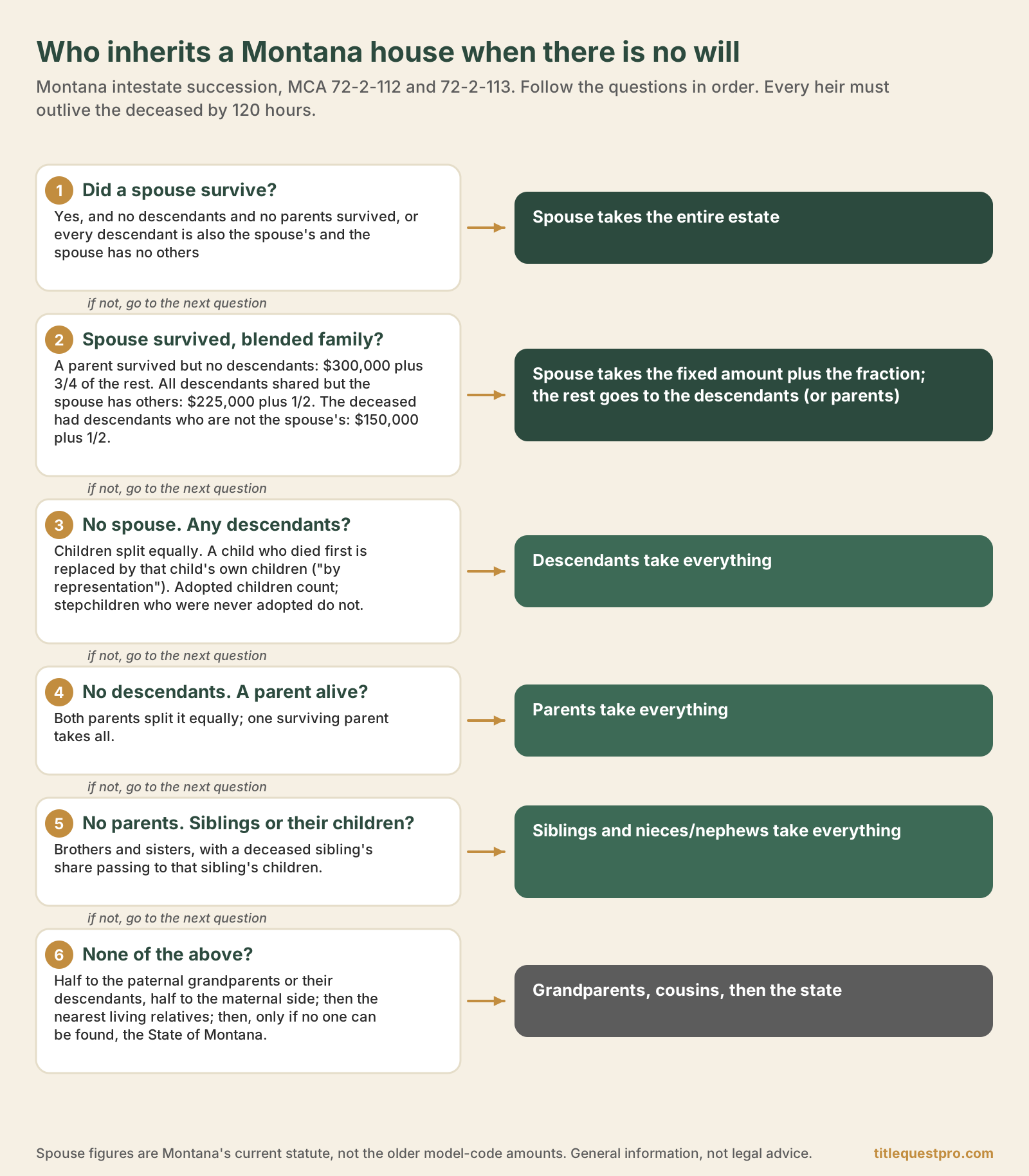
Who inherits under Montana inheritance laws when there is no will
Dying without a will is called dying intestate, and the rules for who inherits are called intestate succession. The Montana inheritance laws that govern it are part of the Uniform Probate Code and lives at Title 72, chapter 2 of the Montana Code Annotated, the state's statute book.
I teach it to families as four steps: spouse first, then down, then up, then out.
Step one: the surviving spouse
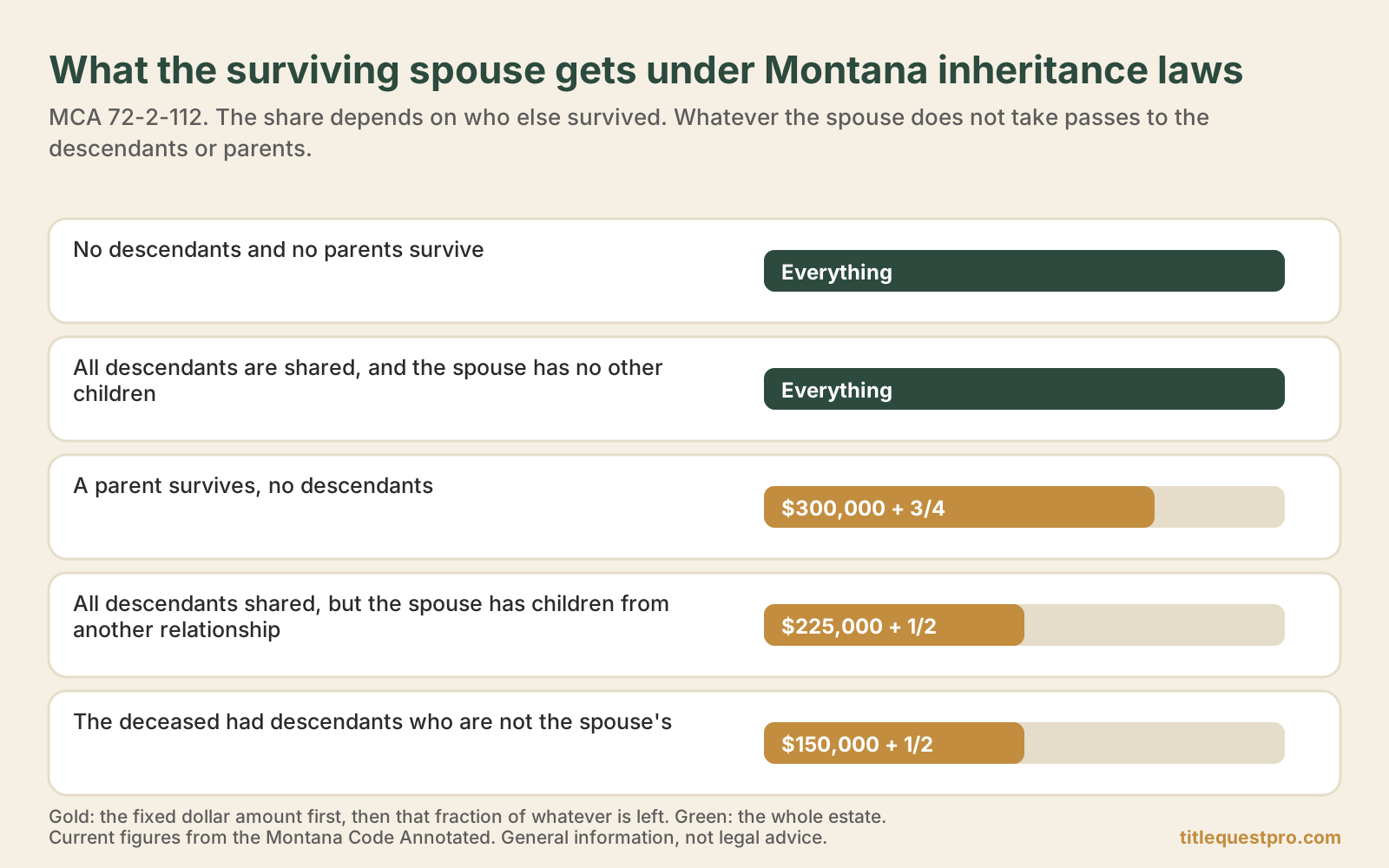
MCA 72-2-112 sets the spouse's share, and it depends on who else survived.
| Who survived the deceased | Surviving spouse receives |
|---|---|
| Spouse, and no descendants and no parents | The entire estate |
| Spouse, and every descendant of the deceased is also the spouse's descendant, and the spouse has no other descendants | The entire estate |
| Spouse and a parent of the deceased, but no descendants | The first $300,000, plus three-quarters of the rest |
| Spouse, all descendants are shared, but the spouse has descendants from another relationship | The first $225,000, plus half of the rest |
| Spouse, and the deceased has one or more descendants who are not the spouse's | The first $150,000, plus half of the rest |
Read the second and last rows carefully, because they are where blended families get surprised. If your dad remarried and had no children with his second wife, she does not automatically get everything. She gets the first $150,000 and half of what remains, and you and your siblings split the other half. On a house worth more than that, the kids from the first marriage own a real share.
These figures are Montana's own, straight from the current statute. Many national websites still show the older Uniform Probate Code numbers, which are lower. The statute linked above is current.
Step two: down to descendants
If there is no surviving spouse, or after the spouse's share is set aside, MCA 72-2-113 sends the rest to the deceased person's descendants "by representation." That means the children split it equally, and if a child died first, that child's own children split the share their parent would have taken.
Adopted children count as descendants. Stepchildren who were never adopted do not. Children born outside marriage inherit from both parents once parentage is established.
Step three: up to parents
No spouse and no descendants: the estate goes to the deceased person's parents, equally if both are alive, all to the survivor if one is.
Step four: out to siblings, grandparents, and cousins
No spouse, descendants, or parents: to the descendants of the parents, which means siblings, and the children of siblings who died first. After that, half to the paternal grandparents or their descendants and half to the maternal side. After that, the nearest living relatives by degree. If no one at all can be found, the estate escheats to the state of Montana under MCA 72-2-115, which almost never happens because someone can almost always be found.
The 120-hour rule
An heir has to outlive the deceased by at least 120 hours, five days, to inherit. MCA 72-2-114. This matters in a car accident that takes a parent and a child days apart, and it has to be proven by clear and convincing evidence.
What this means for you: Montana inheritance laws decide who the heirs are on the day of death, automatically, without anyone filing anything. The list can include people the family has not spoken to in years, and every one of them owns a piece of the house.
What "inherit" actually means for a house in Montana
Here is the part that stalls more families than the succession rules do.
MCA 72-3-101 says that at death a person's real and personal property passes to the heirs or devisees, subject to allowances, creditors, the spouse's elective share, and administration. So the heirs own the house from the moment of death. The law already did that.
But the deed on file with the county clerk and recorder still says your father's name. No title company will insure a sale from a dead man, and no buyer with a lender can close. Something has to put the heirs' names on the public record, and in Montana that something is probate. Think of it as the missing paperwork for something that already happened.
Montana has no affidavit of heirship, the recorded document Texas families use to establish heirs without a court. Search for one and you will find Texas forms. The Montana small estate affidavit reaches bank accounts and vehicles only. For real property, a personal representative appointed through probate signs a deed to the heirs, or a court enters an order determining who the heirs are, and that is what the title company records.
What this means for you: being an heir and being able to sell are two different things. Montana inheritance laws make you the owner. Probate makes you the owner on paper, which is the only kind a buyer can buy from.
The five ways a Montana house changes hands after a death
Under Montana inheritance laws and the probate code, every inherited house moves by one of these five routes. The deed tells you which one applies, so pull the deed before you call anyone.
1. Joint tenancy with right of survivorship
If the deed names two owners as joint tenants with right of survivorship, the house went to the survivor at the moment of death. No probate. Record an affidavit of survivorship with the death certificate and it is done. Montana requires joint tenancy to be expressly stated on the deed, under MCA 70-1-307, so "husband and wife" alone is not enough; look for the words.
2. A transfer on death deed
If your parent recorded a transfer on death deed before death naming a beneficiary, the house went to that person without probate. The catch nobody mentions: for one year after the death, the deceased owner's creditors can still reach the property, so title companies will not insure a clean sale and lenders will not fund one until the year runs. I explain the one-year problem and the four ways through it in my post on the Montana transfer on death deed.
3. A trust
If the house was deeded into a living trust, the trustee transfers it under the trust's terms. No probate, no court.
4. Informal probate
If the house was in your parent's name alone, which is the common case, the route is probate. In Montana that usually means informal probate: an application to the clerk of district court, appointment of a personal representative with no hearing, four months of published notice to creditors, and a closing statement no sooner than six months later. It is paperwork with a clerk, not a trial. The timeline, the difference between informal and formal, and what happens if nobody opened probate for years are in my post on probate in Montana.
5. A personal representative's deed, during or after probate
Once appointed, the personal representative can deed the house to the heirs, or sell it to a buyer and distribute the proceeds, without a court order in most cases. The authority, the five documents a title company asks for, and the mistakes to avoid are in the post on what a Montana personal representative can do with the house.
What this means for you: routes one through three skip probate but only if the paperwork was done before the death. Route four is the default, and route five is how the house actually gets sold.
The small estate affidavit does not move the house
I get asked about this every week, so it gets its own section.
The Montana small estate affidavit, under MCA 72-3-1101, lets heirs collect personal property, meaning bank accounts, vehicles, stock, and belongings, thirty days after a death when the probate estate is worth $100,000 or less after liens. The cap was raised from $50,000 in 2023, and most websites have not caught up.
It does not reach real estate. Not a house, not a lot, not mineral rights. A family that spends two months collecting the checking account with the affidavit and then tries to sell the house with it learns at the title company that the house still needs probate. What the affidavit does, the four conditions, and the three-question sort that tells you which tool you need are in my post on the Montana small estate affidavit.
The four clocks running on an inherited Montana house
Montana inheritance laws decide who owns the house. These four statutes decide how much time the owners have.
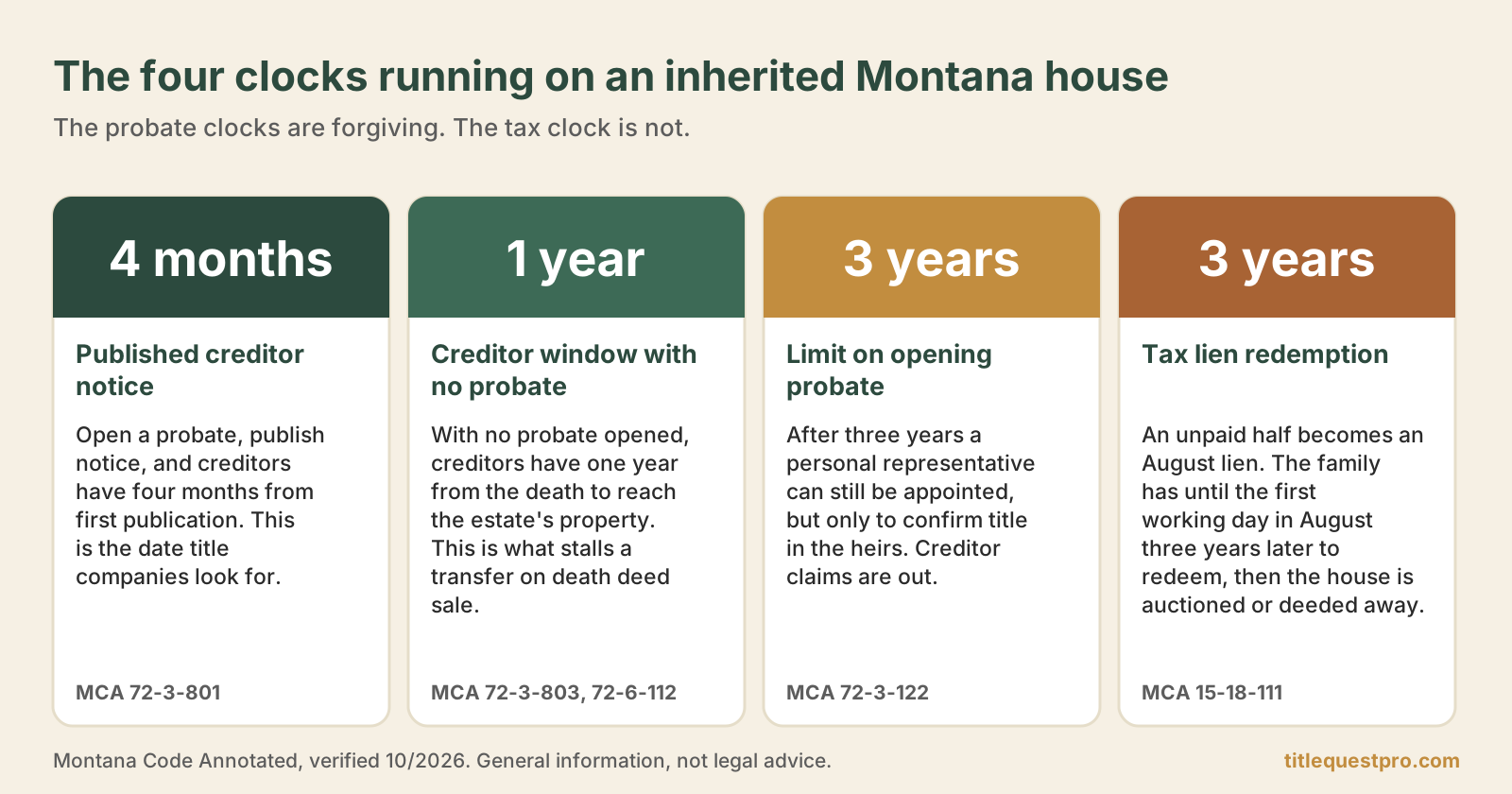
One year: the creditor window. Without a probate, the deceased person's creditors have one year from the death to bring a claim against the estate's property, under MCA 72-3-803. That year is what makes a transfer on death deed hard to sell in the first twelve months.
Four months: the published notice. If a probate is opened and notice to creditors is published, the claim period shrinks to four months from first publication, under MCA 72-3-801. This is the date title companies look for before insuring an estate sale.
Three years: the limit on opening probate. MCA 72-3-122 says probate must generally be opened within three years of death. After that, a personal representative can still be appointed, but only to confirm title in the heirs, which is often exactly what a family needs a decade later.
Three years: the tax lien. Property taxes do not pause for a death. If a half goes unpaid, the county treasurer attaches a lien the first working day in August, and the family has until the first working day in August three years later to redeem. After that the house goes to auction if someone lives in it, or straight to the lien holder by deed if nobody does. The calendar, the assignment notice, and the four moves are in my post on a Montana tax lien on an inherited property.
What this means for you: the probate clock is forgiving. The tax clock is not. If the house has been sitting, find out where the taxes stand before you do anything else.
When the heirs do not agree
Montana inheritance laws make every heir a co-owner. They do not make the co-owners get along.
Three siblings who inherit a house under Montana inheritance laws own it together, each with an undivided one-third. Nobody can sell the whole house without all three signing, or without a personal representative with authority to sell it for the estate. One sibling living in it does not own more of it. One sibling paying the taxes does not own more of it either, though they may be entitled to reimbursement.
What one heir can do is sell their own share. An undivided interest in Montana real property can be sold without the other owners' consent, and that is a path families use when one person wants out and the others will not act. We buy partial heir interests in Montana property for that reason. The other route is a partition action, where a court orders the property sold and the proceeds split, which works but costs money and goodwill.
The quiet version of this problem under Montana inheritance laws is the heir nobody can find. A half-sibling, a cousin from a first marriage, an adopted-out child. Montana inheritance laws give them a share whether or not the family knows where they are, and a title company will want them accounted for.
Finding them is the genealogy and chain-of-title work my team does before we make any offer. It is the part most buyers skip, and it is the part that makes the rest of the deal real.
Out-of-state heirs and Montana property
Most of the heirs I work with do not live in Montana. The property does, so Montana inheritance laws and Montana probate apply to it, no matter where the heirs or the deceased person lived.
An out-of-state heir can serve as personal representative. Everything in an informal probate can be done by mail and email through a Montana attorney, and a sale can close with the heir signing remotely in front of a notary. What out-of-state heirs cannot easily do is watch the mail at the empty house, which is how the tax lien and the creditor notices get missed. If you inherited a Montana house from another state, have the county treasurer send the tax notices to you, now, before anything else.
Where TitleQuest Pro fits
The families who call me are not usually looking for the highest price. They are looking for a way out of a house in a state they do not live in, with siblings who do not agree, a deed in a dead parent's name, and a tax bill nobody has opened.
Here is what we do. You tell us about the property, which takes about five minutes on the form or a call. Our team pulls the deed, the tax history, and the chain of title, and maps the heirs under Montana inheritance laws, including the ones the family has not talked to. That takes one to seven days and is not billed.
If the estate just needs a simple informal probate and a listing, I will say so.
If you would rather be done, we send a written cash offer within 48 hours of the review, with the price and closing in email. You decide. We can buy from a personal representative during probate, from the heirs after one, or one heir's share when the others will not sign. We pay the closing costs and the curative work, including the probate if there was not one, and you sign remotely with a notary.
There is one more thing our team checks before every Montana offer that most buyers skip, and it is usually the thing that makes or breaks the deal. I will walk you through it on the call.
No fees, no obligation, and the offer has no deadline.
Tell us about the property or call (406) 920-1095. If you want to see how the process runs step by step, it is on the how it works page.
Questions I hear about Montana inheritance laws
Under MCA 72-2-112 and 72-2-113, the surviving spouse inherits first, taking the entire estate if there are no descendants or parents, or if all descendants are shared. Otherwise the spouse takes a fixed amount of $150,000 to $300,000 plus a fraction, and the rest goes to descendants, then parents, then siblings, then grandparents and more distant kin.
No. Montana repealed its inheritance tax in November 2000, effective for deaths after January 1, 2001, and has no estate tax for deaths after 2004. Heirs owe the state nothing for inheriting Montana property. The federal estate tax applies only to very large estates and is paid by the estate, not the heir.
It depends on who else survived. The spouse gets everything if the deceased left no descendants or parents, or if every descendant is also the spouse's and the spouse has no others. With a surviving parent but no descendants, the spouse gets $300,000 plus three-quarters of the rest. With stepchildren on either side, the spouse gets $225,000 or $150,000 plus half.
Usually yes, if the house was titled in the deceased person's name alone. Montana has no affidavit of heirship, and the small estate affidavit does not cover real estate. Probate, usually informal through the clerk of district court, is how a personal representative gets authority to deed the house to the heirs or sell it. Joint tenancy, a transfer on death deed, or a trust avoid probate if set up before death.
Generally three years from the date of death, under MCA 72-3-122. After three years, a personal representative can still be appointed, but only to confirm title in the heirs, and creditor claims can no longer be presented. A proceeding to determine who the heirs are has no three-year limit, so a house left in a parent's name for a decade can still be cleared.
One heir cannot sell the whole property alone, but can sell their own undivided share without the other heirs' consent. A personal representative with authority from the probate can sell the whole property for the estate. If heirs cannot agree, a partition action asks the court to order a sale and divide the proceeds.
The bottom line
Montana inheritance laws answer the first question on the day of death: the spouse first, then down, then up, then out, in the shares the statute sets. There is no inheritance tax and no estate tax. The heirs own the house from that moment.
The second question, how to get the house out of the deceased owner's name, is answered by the deed and by probate, not by Montana inheritance laws alone. Joint tenancy, a transfer on death deed, or a trust moves it without court if the paperwork was done in time. Otherwise an informal probate and a personal representative's deed move it, and the tax clock keeps running the whole time.
TitleQuest Pro is not a law firm. This is general information drawn from the Montana Code Annotated and the Montana Department of Revenue, not legal advice. Every family is different, so confirm your situation with a Montana probate attorney or your title company.
If the house is the part you want handled, tell us about it. I read every message myself.

Daniel Bear
Founder, TitleQuest Pro
Daniel has been in real estate since 2016 and today buys inherited houses and untangles the titles other buyers won't touch. He works from Bozeman, Montana, with one foot in Montana and the other on the ground in Texas. TitleQuest Pro is not a law firm; this is general information, not legal advice.
Related reading.
Sell your share of inherited property
Sell your fractional interest without convincing the rest of the family.
Sell your share of inherited property →Sell a house with a tax lien
We close on Texas houses with active tax suits.
Sell a house with a tax lien →Clear title on inherited property
How to clear clouded title on inherited Texas property.
Clear title on inherited property →Ready when you are.
When you're ready to talk, we're here. Fill out the form, give us a call, or book a 15-minute conversation with Daniel. We'll handle the next step.
Tell us about the property.
We'll review it. We'll call you back within 24 hours. No pressure, no fees, no obligation.