Montana
Montana Personal Representative: Can You Sell the House During Probate?
By Daniel Bear · Montana · October 7, 2026

By Daniel Bear, founder of TitleQuest Pro. In real estate since 2016, based in Bozeman, buying inherited Montana property and paying for the curative title work himself.
The clerk handed you a certified copy of your letters and congratulated you. You are now the Montana personal representative of your father's estate. Then you called a real estate agent about the house in Missoula and she asked a question you could not answer: "Are you allowed to sign a contract yet, or do we need the court?"
You have the authority. You probably do not have a clear picture of what it covers.
This post explains what a Montana personal representative can do with real property, when the title company will actually let you close, who has to agree, and the handful of mistakes that turn a four-month sale into a year-long fight. I buy houses from personal representatives during probate, so I have watched both the smooth version and the other kind.
Quick answer: A Montana personal representative in an informal, unsupervised probate may sell estate real property for cash or credit without a court order, under MCA 72-3-613, unless the will or a court order restricts it. In practice the sale closes once the title company has certified letters, the death certificate, evidence the four-month creditor period has run, and a personal representative's deed.
What a Montana personal representative actually is
Montana adopted the Uniform Probate Code, so it does not use the words executor or administrator. The person who runs the estate is the personal representative, whether there was a will or not.
The clerk of district court appoints you in an informal probate, with no hearing, and issues letters. Letters testamentary if there was a will, letters of administration if there was not. Those letters are your proof of authority. Every bank, title company, and county office you deal with will want a certified copy, and most will want one dated within the last 60 to 90 days.
Being personal representative is a fiduciary job. The statute's phrase is that you act "reasonably for the benefit of the interested persons," which means the heirs and the creditors, not yourself. You gather the assets, give notice to creditors, pay what is owed, and distribute what is left. In an informal probate you do all of that without the court looking over your shoulder, unless someone asks it to.
What this means for you as a Montana personal representative: your letters are a key, not a leash. They let you act. They also make you answerable to the heirs for how you act.
Can a Montana personal representative sell the house without court approval?
Yes, in the ordinary case.
MCA 72-3-613 is the list of transactions a personal representative may do without a court order, and item 23 says it plainly: a personal representative may "sell, mortgage, or lease any real or personal property of the estate" for cash, credit, or part of each. You sign the contract. You sign the deed. No judge, no hearing, no order confirming the sale.
There are three situations where that is not true.
The will restricts it. A will can say the house goes to a specific person, or that it cannot be sold, or that the personal representative needs the beneficiaries' consent. The will controls. Read it before you list anything.
The probate is supervised. If the court has ordered supervised administration, usually because an heir asked for it, major steps including a sale need court approval. Supervised administration is rare and is chosen, not automatic.
A formal order says otherwise. If someone has opened a formal proceeding and the judge has restricted your powers while a dispute is decided, you are bound by that order.
Outside those three, the authority is yours. The limit on it is not the court. It is the title company.
The five documents a Montana title company will ask for
I call this the five-document closing, because a probate sale in Montana comes down to a title examiner checking five things before issuing a policy. Have them ready and the closing is routine. Miss one and you wait.
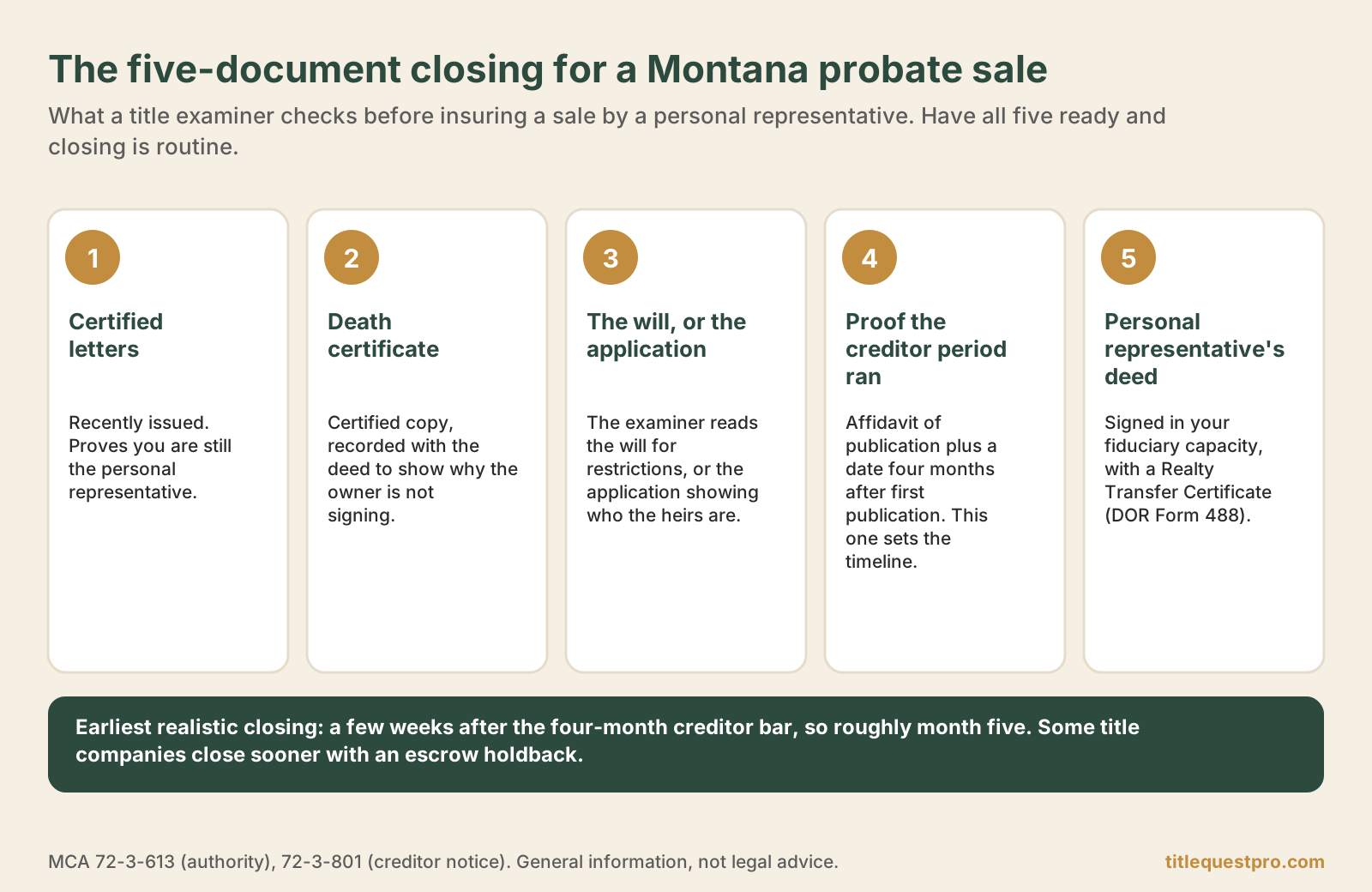
1. Certified letters
A certified copy of your letters, recently issued. The title company is confirming you are still the personal representative and that nothing has been revoked.
2. The death certificate
A certified copy. It gets recorded with the personal representative's deed so the chain of title shows why the deceased owner is no longer signing.
3. The will, or the order admitting it
If there was a will, the title examiner wants to read it, for the restrictions I described above. If there was no will, the examiner wants the application showing who the heirs are, because they are the people entitled to the proceeds.
4. Proof the creditor period has run
This is the one that sets your timeline. Under MCA 72-3-801, you publish notice to creditors once a week for three weeks and creditors have four months from first publication to present a claim. The title company will want the affidavit of publication and a date showing the four months are up.
If you need to close sooner, some title companies will insure with a holdback, meaning part of the sale proceeds sits in escrow until the creditor period ends. Not all will, and the buyer has to agree.
5. The personal representative's deed
A deed from you, in your capacity as personal representative, to the buyer. Montana also requires a Realty Transfer Certificate, Department of Revenue Form 488, with every recorded transfer so the county can update the tax roll. Your attorney or the title company prepares both.
What this means for you: the earliest realistic closing on a Montana probate sale is a few weeks after the four-month creditor bar, so roughly month five. The six-month floor on closing the whole estate under MCA 72-3-1004 does not stop the sale; it only stops you from filing the closing statement.
Do the heirs have to agree?
Legally, in an unsupervised informal probate, no. The statute gives the authority to the personal representative, not to a vote of the heirs.
Practically, yes, or at least do not surprise them. Any heir can petition the court to convert the probate to supervised administration, to remove you, or to block a specific sale they think is below value. One sibling who feels blindsided can turn a clerk's-office probate into a courtroom one. Every long probate I have seen in Montana started with a Montana personal representative who stopped communicating.
So tell the heirs what you are doing, show them the offers, and get their agreement in writing when you can. Many title companies will ask for a consent signed by the heirs even though the statute does not require one, precisely because it prevents the dispute that would cloud the policy.
Two special cases. If you, the personal representative, want to buy the house yourself, get written consent from every heir or a court order first. A fiduciary selling estate property to themselves is the fastest route to a formal proceeding.
And if one heir wants to keep the house and the others want to sell, that is a negotiation, not a probate question. The personal representative's duty is to the estate as a whole, which usually means fair market value, and a buyout at that value is the clean answer.
What happens to the money
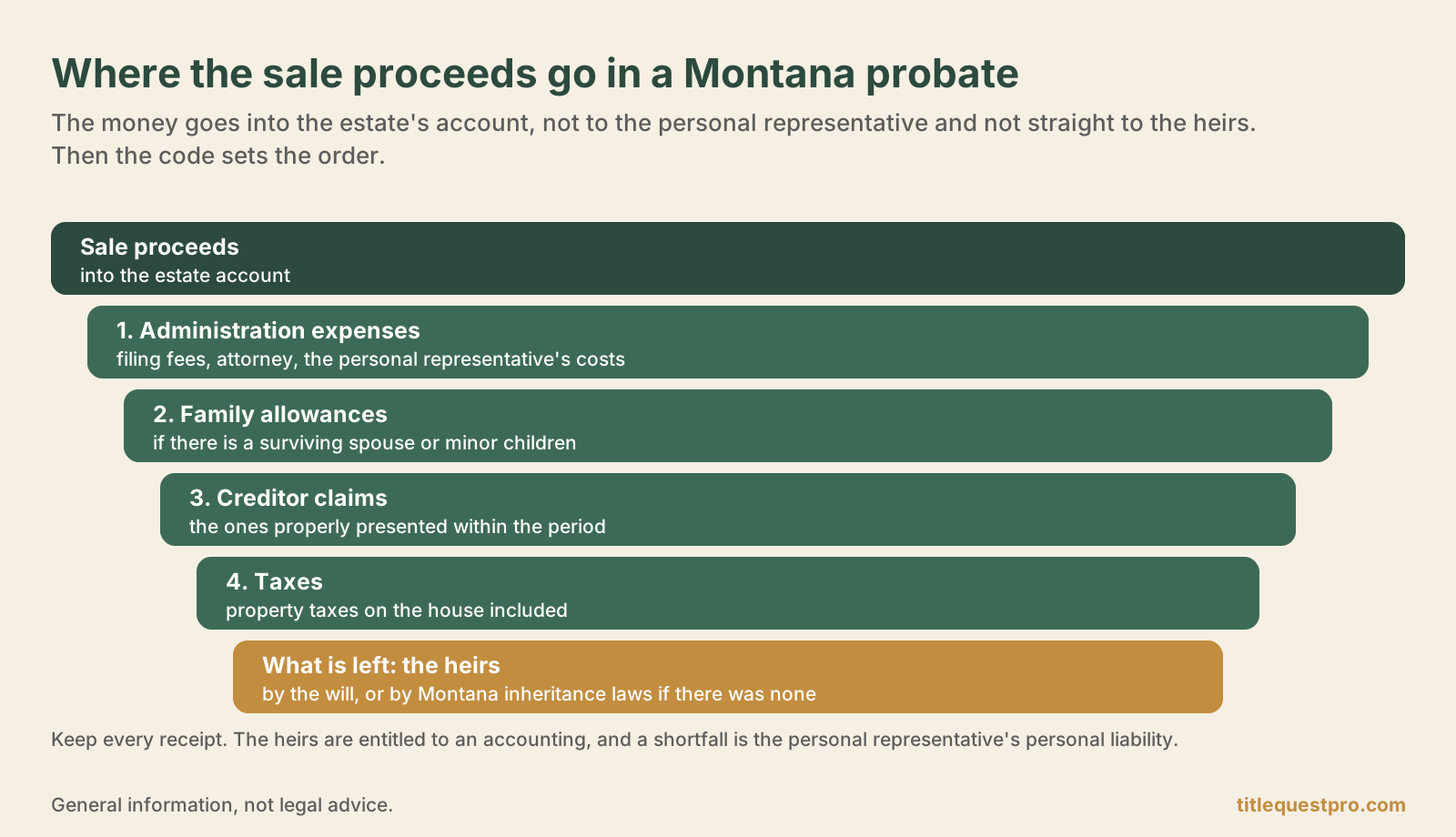
The sale proceeds do not go to you and they do not go straight to the heirs. They go into the estate's account.
From there the order is fixed by the code: administration expenses, then the family allowances if there is a surviving spouse or minor children, then creditor claims that were properly presented, then taxes. What is left is distributed to the people named in the will or, if there was no will, to the heirs in the shares set by the Montana inheritance laws. Then you file the sworn closing statement no sooner than six months after your appointment.
If you want the whole process laid out, from application to closing statement and the three-year rule, that is in my post on probate in Montana. This post stays on the house.
Keep every receipt. The heirs are entitled to an accounting, and a personal representative who cannot show where the money went is personally liable for the gap.
What this means for you: selling the house is often the whole point of the probate. The proceeds pay the debts and the taxes, and whatever is left is what the family actually inherits.
Three mistakes Montana personal representatives make with the house
I see these over and over, and each one is avoidable.
Letting the property taxes go delinquent
The estate owes the taxes from the day of death. Montana's deadlines are November 30 and May 31, with a 2 percent penalty and ten percent annual interest the day after. If a half goes unpaid, the county treasurer attaches a tax lien the first working day in August and a three-year clock toward a tax deed begins.
The full timeline is in my post on a Montana tax lien on an inherited property. Pay the taxes out of the estate before anything else, or tell the heirs plainly that nobody is paying them.
Letting the insurance lapse
Most homeowner policies end at death or when the house goes vacant. Call the carrier, get a vacancy endorsement or a new policy in the estate's name, and keep it current until closing. A frozen pipe in January in an uninsured estate house is a loss the personal representative has to explain.
Signing before the letters issue
A contract signed before you are appointed is not binding on the estate. Agents in a hurry will push for a listing agreement the week of the funeral. Wait for the letters. Then list.
Selling to a cash buyer during probate
For a lot of the families I work with, the house is the estate and the probate is the obstacle. The heirs live out of state, the house needs work nobody wants to pay for, the taxes are behind, and the personal representative is a sibling with a full-time job who did not ask for this.
A cash sale during probate solves most of that for a Montana personal representative. No lender, so no appraisal and no financing contingency. The buyer can accept a holdback if the creditor period has not run. The house sells as-is, so nobody flies in to clear out the garage.
Here is how TitleQuest Pro does it. You tell us about the property, which takes about five minutes on the form or on a call. Our team pulls the deed, the tax history, and the chain of title, and confirms who the heirs are. That takes one to seven days and is not billed.
We send a written cash offer within 48 hours of the review, with the price and closing laid out in email.
You decide, and you show the heirs. If it is a yes, we close within days of the title company being satisfied, you sign the personal representative's deed remotely with a notary, and we pay the closing costs and any curative work the title needs. There is one more thing our team checks before every Montana offer that most buyers skip, and it is usually the thing that makes or breaks the deal. I will walk you through it on the call.
The offer has no deadline. If a listing on the open market is the better move for the estate, I will say so, because your duty is to the heirs and I would rather you meet it.
Tell us about the property or call (406) 920-1095.
Questions I hear from Montana personal representatives
Yes, in an informal, unsupervised probate. MCA 72-3-613(23) lets a personal representative sell, mortgage, or lease estate real or personal property without a court order, unless the will restricts the sale, the administration is supervised, or a formal court order limits the personal representative's powers. Title companies still require proof the creditor period has run.
The statute sets no waiting period, but the title company usually wants the four-month creditor period under MCA 72-3-801 to have run before it will insure the sale. That puts the earliest realistic closing around month five after appointment. Some title companies will close earlier with a holdback of part of the proceeds.
No. The personal representative alone signs the deed in an unsupervised probate. In practice, title companies often ask for written consent from the heirs, and any heir can petition the court to supervise or block a sale they believe is improper. Keeping the heirs informed and in agreement is the practical requirement even where it is not the legal one.
The personal representative signs a personal representative's deed in their fiduciary capacity, not the heirs individually. The deed is recorded with a certified copy of the letters and the death certificate, plus a Montana Realty Transfer Certificate, Department of Revenue Form 488, so the county can update ownership and the tax roll.
A personal representative is a fiduciary and can be personally liable for losses caused by breaching that duty: selling below value to a related party, letting taxes or insurance lapse, distributing to heirs before creditors are paid, or failing to account for estate funds. Acting reasonably, documenting decisions, and keeping heirs informed are the protections the code expects.
Yes. The code requires the personal representative to act reasonably for the benefit of the interested persons; it does not require a listing or a particular marketing method. A cash sale during probate is common when the estate needs liquidity, the property needs work, or the heirs want certainty. Document why the price is reasonable, and get the heirs' agreement in writing.
The bottom line
A Montana personal representative with letters in hand can sell the estate's house without asking the court, unless the will or a judge says otherwise. The real gate is the title company, and it opens when the four-month creditor period has run and you can produce the five documents.
Keep the heirs informed, keep the taxes and insurance paid, and do not sign anything before the letters issue. Do those three things and a probate sale in Montana is a closing, not a case.
TitleQuest Pro is not a law firm. This is general information drawn from the Montana Code Annotated, not legal advice. Every estate is different, so confirm your situation with a Montana probate attorney or your title company.
If you are the Montana personal representative and the house is the part you want handled, tell us about it. I read every message myself.

Daniel Bear
Founder, TitleQuest Pro
Daniel has been in real estate since 2016 and today buys inherited houses and untangles the titles other buyers won't touch. He works from Bozeman, Montana, with one foot in Montana and the other on the ground in Texas. TitleQuest Pro is not a law firm; this is general information, not legal advice.
Related reading.
Sell your share of inherited property
Sell your fractional interest without convincing the rest of the family.
Sell your share of inherited property →Sell a house with a tax lien
We close on Texas houses with active tax suits.
Sell a house with a tax lien →Clear title on inherited property
How to clear clouded title on inherited Texas property.
Clear title on inherited property →Ready when you are.
When you're ready to talk, we're here. Fill out the form, give us a call, or book a 15-minute conversation with Daniel. We'll handle the next step.
Tell us about the property.
We'll review it. We'll call you back within 24 hours. No pressure, no fees, no obligation.