Montana
Probate in Montana: Informal vs Formal, How Long It Takes, and the 3-Year Rule
By Daniel Bear · Montana · October 7, 2026
By Daniel Bear, founder of TitleQuest Pro. In real estate since 2016, based in Bozeman, buying inherited Montana property and paying for the curative title work himself.
The lawyer said it almost in passing. "We will need to open probate before you can sell the house." And your stomach dropped, because the word probate means a year of court dates, a bill you cannot predict, and a house in Great Falls sitting empty through another winter while you live two states away.
Most of what you are picturing is not how probate in Montana works.
Montana runs the Uniform Probate Code, and for an ordinary estate the process is handled by a clerk, not a judge, with no hearing and no courtroom. It still takes months, and there are clocks inside it you need to know about, including one that matters if your parent died years ago and nobody did anything. This post walks through all of it the way I explain it to families across my kitchen table.
Quick answer: Probate in Montana is usually informal: an application to the clerk of district court, appointment of a personal representative without a hearing, a four-month creditor notice period, and closing by sworn statement no sooner than six months after appointment. Formal probate goes before a judge and is used when there is a dispute. Probate must generally be opened within three years of death, though a late appointment to confirm title is still possible after that.
The two kinds of probate in Montana
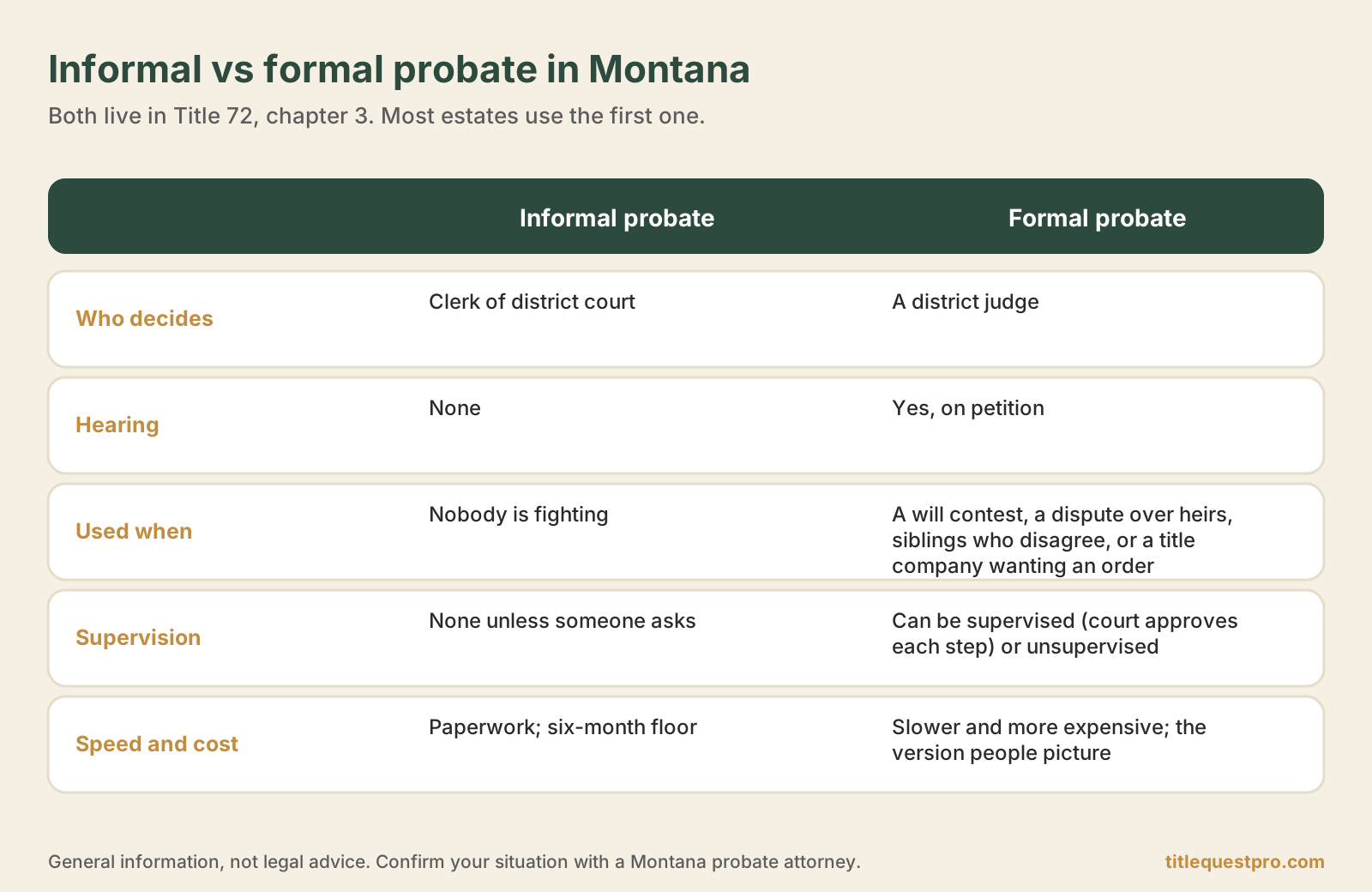
The rules for probate in Montana are Title 72, chapter 3 of the Montana Code Annotated, the state's book of statutes. It gives you two tracks.
Informal probate
This is the default and it is the one most families use. You, or your attorney, file an application with the clerk of district court in the county where your parent lived. The clerk reviews it, admits the will if there is one, and appoints a personal representative. That is Montana's term for the executor or administrator.
No hearing, no judge, no courtroom appearance.
The personal representative gets a document called letters, either letters testamentary if there was a will or letters of administration if there was not. Letters are the proof of authority. A bank, a title company, the DMV, all of them will ask for a certified copy.
From there the personal representative administers the estate without court supervision. They gather assets, publish notice to creditors, pay valid debts, and distribute what is left. The court is not involved unless someone asks it to be.
Formal probate
Formal probate starts with a petition and ends with a judge's order. You use it when something needs deciding: a will contest, a question about who the heirs are, a dispute between siblings about whether to sell, or a title company that wants a court order confirming the heirs before it will insure.
Formal probate can be supervised, meaning the court approves each major step, or unsupervised, meaning the judge decides the contested question and the personal representative carries on informally afterward. Supervised administration is the slow, expensive version people picture when they hear the word probate. It is rare, and it is chosen, not automatic.
What this means for you: if nobody is fighting, probate in Montana is paperwork with a clerk. The judge only enters the picture when a question needs a ruling.
The six-month floor: how long probate in Montana actually takes
Here is the timeline for a clean informal probate. I call it the six-month floor because the statute sets a minimum, and most estates land somewhere above it.
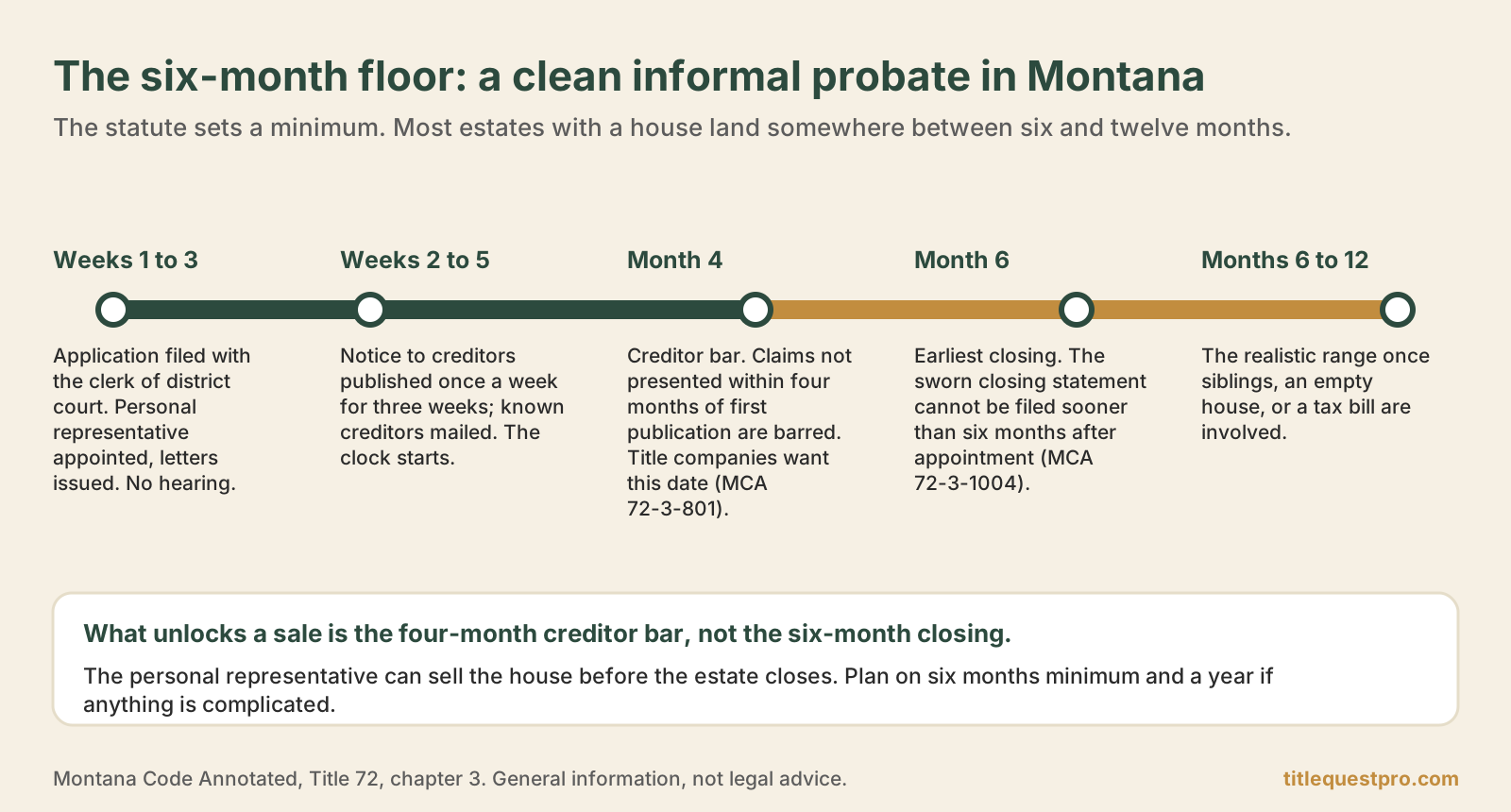
Weeks 1 to 3: application and appointment. The application is filed, the clerk reviews it, and the personal representative is appointed. In a county without a backlog this can happen within days.
Weeks 2 to 5: notice to creditors. Under MCA 72-3-801, the personal representative publishes a notice in a local newspaper once a week for three consecutive weeks, and mails notice to any creditor they know about. This is the step that starts the most important clock.
Month 4: the creditor bar. Creditors have four months from the first publication to present a claim. After that, claims are barred. Title companies care about this date more than any other, because once it passes, the estate can sell the house without an unknown creditor appearing later.
Month 6: earliest closing. Under MCA 72-3-1004, the personal representative can close an informal probate by filing a sworn statement, but not sooner than six months after the original appointment. The statement says the creditor period has run, debts and taxes are paid, and assets have been distributed.
Months 6 to 12: the realistic range. MSU Extension's guide to probate in Montana says that in some situations probate can be finished within six months. In my experience the probate in Montana that hits the floor is an estate with one heir, one house, no debts, and a personal representative who lives in-state and answers email. Add siblings in three time zones, a house that needs to be emptied, or an unpaid tax bill, and you are closer to a year.
If an estate is still open two years after appointment, the Supreme Court administrator notifies the district judge under MCA 72-3-1015. That is not a penalty, but it is the state's way of saying this should be done by now.
What this means for you: plan on six months minimum, a year if anything is complicated, and know that the four-month creditor date is the one that unlocks a sale.
What stretches a Montana probate past a year
Every long probate I have seen had at least one of these.
Nobody can agree on who should be personal representative. Montana has a priority list, and when two siblings each want the job, you are in formal probate before you have started.
An heir cannot be found. The personal representative has to give notice to every heir. A half-brother nobody has heard from since 2009 has to be located, or the court has to be satisfied you tried.
The will is missing or was never signed right. Montana requires two witnesses, and a will with one signature or no original copy means a formal proceeding to prove it, or an intestate estate under the Montana inheritance laws for people who die without a will.
The house has a problem of its own. Delinquent taxes with a lien already attached, a mortgage in default, a boundary question, a tenant. None of these stop probate, but each one has to be handled before the house can be sold or distributed, and the personal representative is the one who has to handle it.
The personal representative is overwhelmed. This one is the most common. A grieving adult child, working full time, in another state, with a stack of forms. The estate does not move because the person running it cannot.
The three-year rule, and what happens if nobody opened probate
This is the question I get from Montana families more than any other, usually years after the fact. Mom died in 2017. Nobody opened probate. The house is still in her name.
Now a sibling wants to sell, or the county is sending tax notices, or someone found out there was a will.
MCA 72-3-122 says that a probate or appointment proceeding may not be started more than three years after the death, with a short list of exceptions. People read that and assume the door is closed.
It is not closed. It is narrower. The same section says that after three years, a personal representative can still be appointed, but their authority is limited to what is "necessary to confirm title to the property in the successors." They cannot pay creditors, because creditor claims other than administration expenses cannot be presented at all.
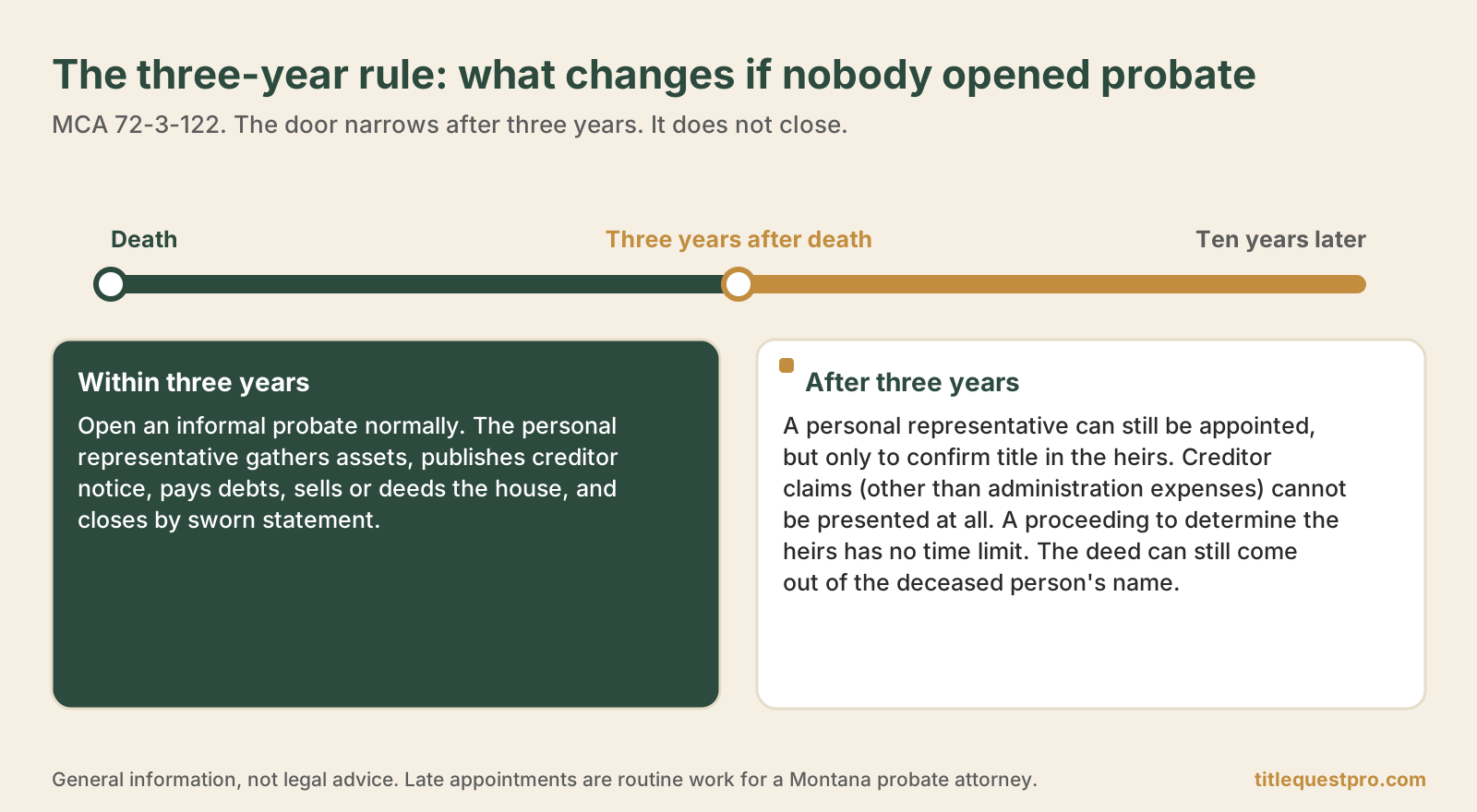
In practice, that is often good news. A late appointment is a tool for exactly one job: getting the deed out of the deceased person's name and into the heirs' names. The creditor problem has already solved itself, because the one-year outside limit on claims in MCA 72-3-803 ran out long ago.
The three-year limit also does not apply to a proceeding to determine who the heirs are. So a family can ask the court to declare the heirs of an intestate estate a decade later. That determination, recorded, is what a title company wants to see before insuring a sale.
What this means for you: if your parent died years ago and the house is still in their name, you are not stuck. You need a late appointment or a determination of heirship, and a title company willing to work from it. That is routine work for a Montana probate attorney, and it is the kind of clouded title my team researches before we buy.
Do you even need probate in Montana?
Sometimes the answer is no, and it depends entirely on how the house was titled.
If the deed shows joint tenancy with right of survivorship and the other owner is alive, the house went to them at the moment of death. Recording an affidavit of survivorship with the death certificate is all it takes.
If a transfer on death deed was recorded before the death, the house went to the named beneficiary without probate. There is a one-year creditor catch that stops most sales during that first year, which I explain in the post on the Montana transfer on death deed.
If the house was in a living trust, the trustee handles it under the trust, not the court.
If the house was in your parent's name alone, probate is how the title moves. There is no shortcut. The Montana small estate affidavit reaches bank accounts and vehicles up to $100,000 and does not touch real estate, and Montana has no affidavit of heirship. The only way to put a house that was titled in the deceased person's name into anyone else's name is a deed signed by a personal representative or a court order.
What this means for you: pull the deed before you pay anyone. The deed tells you whether you need probate at all.
Selling the house while probate is open
You do not have to wait for probate to close to sell. A Montana personal representative has statutory authority under MCA 72-3-613 to sell estate real property without a court order in an informal, unsupervised probate. The practical constraint is the title company, which will usually want the four-month creditor period to have run, or a bond or holdback to cover it.
How that works, what a title company asks for, and what a personal representative can and cannot agree to are in my post on what a Montana personal representative can do with the house.
For the families I work with, this is usually the whole point of opening probate. The house is the estate. Selling it is how the estate gets settled and how the siblings get paid.
Where TitleQuest Pro fits
Most of the people who call me about probate in Montana are not looking for a legal education. They are looking for a way out of a house that is sitting empty in a state they do not live in, with a tax bill coming and a process they did not sign up for.
Here is what we do. You tell us about the property, which takes about five minutes on the form or a call. Our team pulls the deed, the tax history, and the chain of title, and maps the heirs. That takes one to seven days and is not billed.
If the estate just needs a simple informal probate and a listing, I will say so.
If you would rather be done, we send a written cash offer within 48 hours of the review, with the price and closing in writing. You decide. We can buy from a personal representative during probate, buy from the heirs after a late appointment, or buy one heir's share when the others will not sign. We pay the closing costs and the curative work, and you sign remotely with a notary.
There is one more thing our team checks before every Montana offer that most buyers skip, and it is usually the thing that makes or breaks the deal. I will walk you through it on the call.
No fees, no obligation, and the offer has no deadline.
Tell us about the property or call (406) 920-1095.
Questions I hear about probate in Montana
A clean informal probate in Montana takes six months at minimum, because the personal representative cannot close the estate by sworn statement until six months after appointment under MCA 72-3-1004. Most estates with a house run six to twelve months. Disputes, missing heirs, or a formal proceeding before a judge can push it past a year.
Informal probate is handled by the clerk of district court without a hearing; the personal representative is appointed and administers the estate without court supervision. Formal probate is a court proceeding before a judge, used when there is a dispute over the will, the heirs, or the administration. Most Montana estates use informal probate.
Generally three years from the date of death, under MCA 72-3-122. After three years, a personal representative can still be appointed, but only to confirm title in the heirs or devisees, and creditor claims other than administration expenses cannot be presented. A proceeding to determine heirs has no three-year limit.
For real property, only if the house already passed outside probate: joint tenancy with right of survivorship, a transfer on death deed recorded before death, or a living trust. If the house was titled in the deceased person's name alone, probate is required to transfer it. Montana's small estate affidavit covers personal property only, up to $100,000.
The personal representative is appointed by the clerk or court and holds letters as proof of authority. They gather the estate's assets, publish and mail notice to creditors, pay valid debts and taxes, manage or sell property, and distribute what is left to the heirs or devisees. In informal probate they act without court supervision, including selling real estate.
Yes. In an informal, unsupervised probate the personal representative can sell estate real property without a court order under MCA 72-3-613. Title companies typically want the four-month creditor period to have run before insuring the sale, or a holdback to cover unresolved claims. The sale proceeds go to the estate and are distributed when it closes.
The bottom line
Probate in Montana is not the courtroom ordeal most people picture. For an ordinary estate it is an application to a clerk, four months of published notice, and a sworn closing statement no sooner than month six. The judge appears only when something is disputed.
The clocks that matter are the four-month creditor bar, which unlocks a sale, the six-month floor on closing, and the three-year limit on opening probate, which narrows the door but does not shut it. If your parent's house is still in their name years later, a late appointment or a determination of heirship can still move it.
TitleQuest Pro is not a law firm. This is general information drawn from the Montana Code Annotated and MSU Extension, not legal advice. Every estate is different, so confirm your situation with a Montana probate attorney or your title company.
If the house is the part you want gone, tell us about it. I read every message myself.

Daniel Bear
Founder, TitleQuest Pro
Daniel has been in real estate since 2016 and today buys inherited houses and untangles the titles other buyers won't touch. He works from Bozeman, Montana, with one foot in Montana and the other on the ground in Texas. TitleQuest Pro is not a law firm; this is general information, not legal advice.
Related reading.
Sell your share of inherited property
Sell your fractional interest without convincing the rest of the family.
Sell your share of inherited property →Sell a house with a tax lien
We close on Texas houses with active tax suits.
Sell a house with a tax lien →Clear title on inherited property
How to clear clouded title on inherited Texas property.
Clear title on inherited property →Ready when you are.
When you're ready to talk, we're here. Fill out the form, give us a call, or book a 15-minute conversation with Daniel. We'll handle the next step.
Tell us about the property.
We'll review it. We'll call you back within 24 hours. No pressure, no fees, no obligation.