Montana
Montana Small Estate Affidavit: $100,000 Cap, 30 Days, and Why It Won't Move the House
By Daniel Bear · Montana · October 7, 2026

By Daniel Bear, founder of TitleQuest Pro. In real estate since 2016, based in Bozeman, buying inherited Montana property and paying for the curative title work himself.
You searched "Montana small estate affidavit," found a form, and felt relief. Dad's estate was not big. A truck, a checking account, the house in Billings he bought in 1987. Thirty days and a notarized page and you could skip the lawyer.
Then the title company looked at the form and said the sentence I hear more than any other: that does not work for real estate.
They are right, and the websites that led you here are mostly wrong about the rest of it too.
This post lays out exactly what a Montana small estate affidavit does, the number most sites still get wrong, the thirty-day rule, and what actually clears title to the house. I buy inherited Montana property and my team sorts out which tool fits before we ever make an offer, so this is the version I wish families had read first.
Quick answer: A Montana small estate affidavit, under MCA 72-3-1101, lets a successor collect a deceased person's personal property, such as bank accounts, vehicles, and stock, once 30 days have passed and the probate estate is worth $100,000 or less after liens. It does not transfer real estate. A house or land in Montana passes only through probate or a deed that worked outside probate.
What a Montana small estate affidavit actually is
The Montana small estate affidavit is formally called "collection of personal property by affidavit." It lives at MCA 72-3-1101, in the state's probate code. The idea is simple. When someone dies with a small amount of stuff and no probate pending, the person entitled to inherit can hand a sworn affidavit to whoever is holding the property, and that holder can release it without a court order.
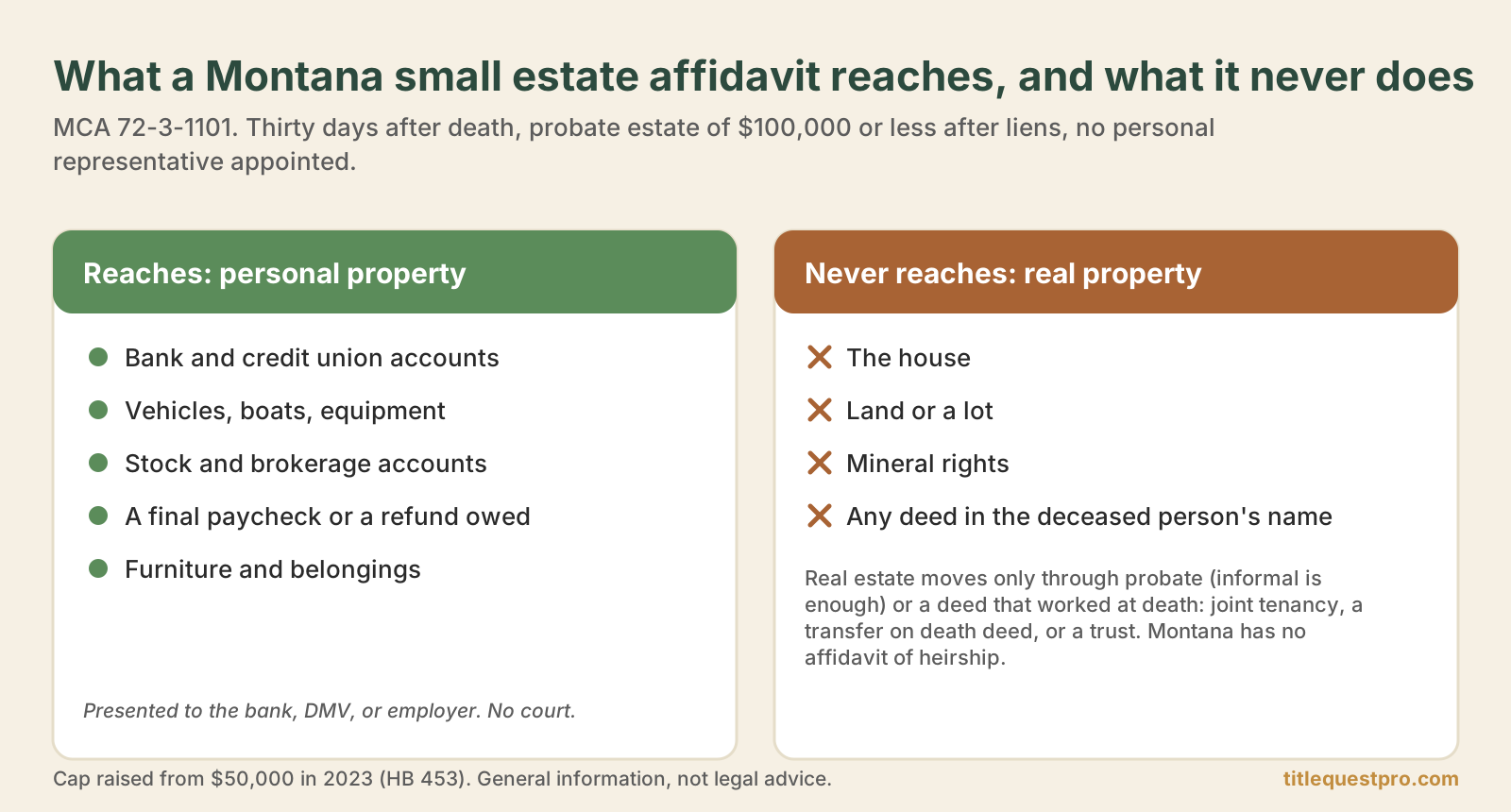
The statute names what it reaches: "tangible personal property or an instrument evidencing a debt, obligation, stock, or chose in action." In plain English, that is bank and credit union accounts, vehicles, boats, equipment, stock and brokerage accounts, a final paycheck, a refund the state owes, and physical belongings.
Real property is not on that list. Not the house, not the lot, not the mineral rights.
What this means for you: the Montana small estate affidavit is a tool for collecting, not for transferring title. A bank can hand you the balance of an account on the strength of it. The clerk and recorder cannot put a deed in your name on the strength of it, because the statute never gave the affidavit that power.
The number everyone gets wrong: it is $100,000 now
If you read that the Montana small estate affidavit cap is $50,000, you read an old page. The 2023 Legislature raised it, in House Bill 453, and the current statute says the affidavit is available when "the value of the probate estate, wherever located, less liens and encumbrances, does not exceed $100,000."
Three details inside that sentence matter.
Probate estate only. The cap counts property that would otherwise go through probate. Anything that passed outside probate does not count. A joint bank account that went to the surviving owner, a life insurance policy with a named beneficiary, a retirement account with a beneficiary form, a house held in joint tenancy, a house that passed by a recorded transfer on death deed: none of those count toward the $100,000.
Less liens and encumbrances. It is a net figure. A $30,000 truck with a $20,000 loan counts as $10,000.
Wherever located. Montana probate assets in another state still count toward the cap.
So an estate can be larger than it looks and still qualify, if most of the value sits in assets with beneficiaries. And an estate can be smaller than it looks and still fail to qualify, if the house is the main asset and it has to go through probate, because the house is in the probate estate even though the affidavit cannot touch it.
What this means for you: add up only the probate assets, subtract what is owed on them, and compare to $100,000. If the house is a probate asset, it is in that total. If the total is over, the affidavit is off the table for everything, not just the house.
The 30-day rule and the other conditions
The statute sets four conditions, and the affidavit itself has to swear to them.
- Thirty days have passed since the death.
- The probate estate, net of liens, does not exceed $100,000.
- No application or petition for appointment of a personal representative is pending or has been granted in any jurisdiction.
- The person signing is entitled to the property, as an heir under Montana inheritance laws or as a devisee under the will.
The thirty days is a waiting period, not a deadline. You can use the affidavit a year later if the other conditions still hold. The purpose of the wait is to give anyone who wants to open a real probate a chance to do it first.
The third condition is the one that trips families up. If a sibling has already filed to be appointed personal representative, even informally, the affidavit route closes. One process or the other, not both.
The form itself is short: the decedent's name and date of death, a statement that each condition is met, a description of the property being claimed, and a notarized signature. Present it with a certified death certificate to the bank, the DMV, or whoever holds the asset. The holder is protected by statute when it pays out on a proper affidavit, which is why most of them accept it without argument.
Why the Montana small estate affidavit does not reach the house
Families push back on this, so let me be specific about why.
Montana has no small-estate procedure for real property. Some states do. Texas, for example, has an affidavit of heirship that can be recorded in the deed records to establish who inherited land, and its small estate affidavit can reach a homestead. People moving from those states, or reading national form sites, assume Montana has the same.
It does not. There is no affidavit of heirship in Montana. Search for one and you will find Texas forms and generic templates that no Montana clerk and recorder will treat as a transfer.
What Montana has instead is a rule in MCA 72-3-102 that a will has to be admitted to probate, by the clerk informally or by the court formally, before it can prove a transfer of property. And for someone who died without a will, title to the land passed to the heirs at the moment of death under MCA 72-3-101, but subject to administration. The paperwork that shows the world who those heirs are comes out of a probate.
What about "summary administration"?
You may see MCA 72-3-1103 and 72-3-1104 described as a small-estate shortcut. They are not a real-estate shortcut. Summary administration still requires a personal representative to be appointed through probate.
What it does is let a very small estate, one worth no more than the family allowances and the funeral and last-illness bills, skip the creditor notice period and close by sworn statement. Useful, but it begins with the same appointment the affidavit was supposed to avoid.
What this means for you: if there is a house, there is a probate, unless the house already left the estate by a deed that worked at death. The only question is which kind of probate and how small you can keep it.
The three-question sort: which tool fits your estate
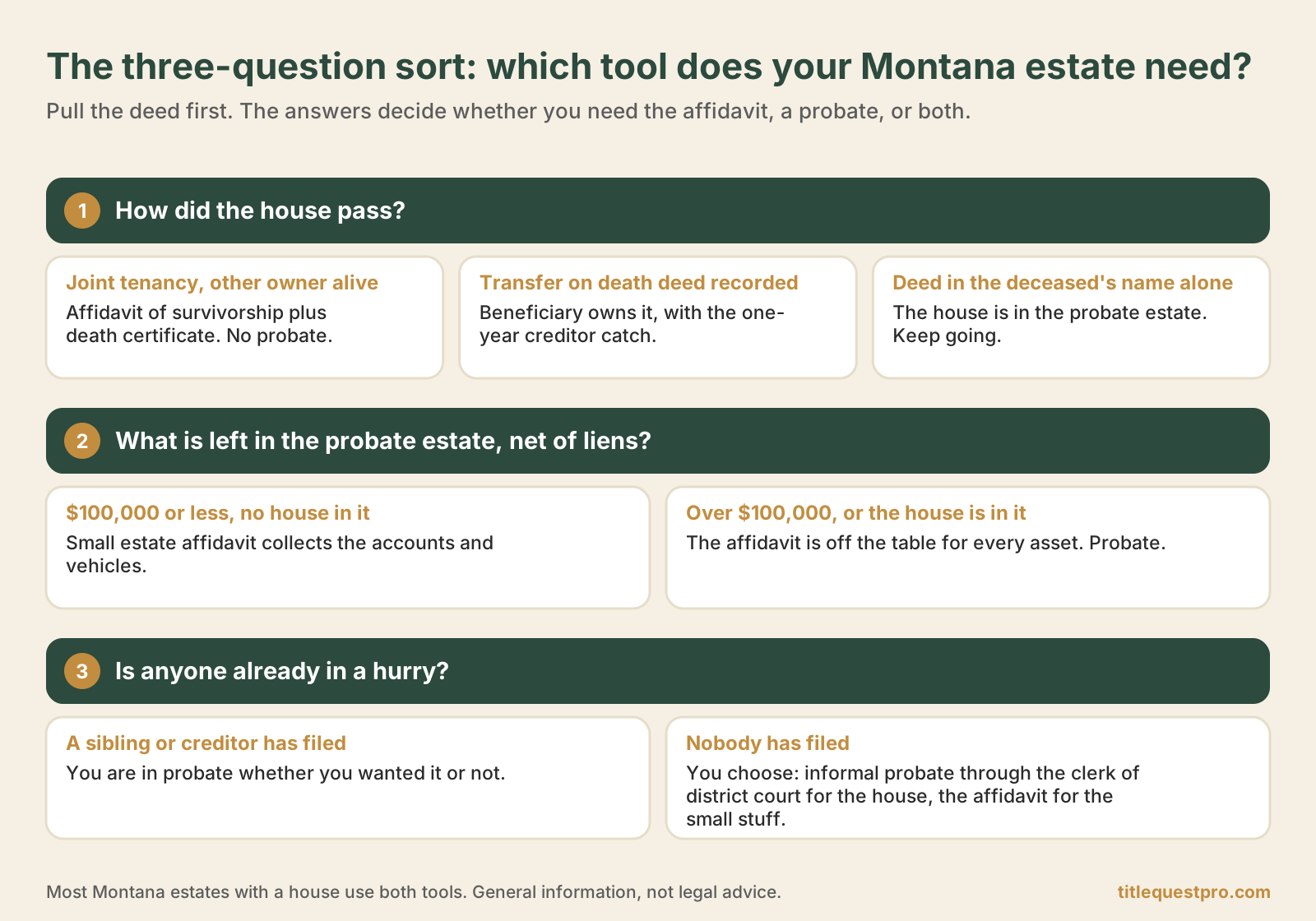
When a family calls me unsure what to file, I ask three questions. They settle it faster than any chart.
Question 1: How did the house pass?
Pull the deed. If it says joint tenancy with right of survivorship and the other owner is alive, the house went to them at death and needs only an affidavit of survivorship and a death certificate recorded. If a transfer on death deed was recorded before the death, the house went to the named beneficiary, with a one-year creditor catch I explain in the post on the Montana transfer on death deed. If the deed just says the deceased person's name, the house is in the probate estate.
Question 2: What is left in the probate estate, net of liens?
If the house is in the probate estate, the answer is almost always more than $100,000 in Montana, which ends the affidavit question. If the house passed outside probate and what remains is a car and a checking account, the Montana small estate affidavit handles the remainder cleanly.
Question 3: Is anyone already in a hurry?
If a sibling has filed, or a creditor has, you are in probate whether you wanted it or not. If nobody has, you choose. For a house, that choice is informal probate, which in Montana is handled by the clerk of district court without a hearing. I walk through what that looks like, how long it takes, and the three-year limit in the post on probate in Montana.
What this means for you: the Montana small estate affidavit and the probate are not competitors. Most Montana estates with a house use both. The affidavit collects the small stuff. The probate moves the house.
What a stalled estate costs while you figure this out
I want to be honest about the clock, because the affidavit confusion usually burns three to six months before a family learns it needs a probate anyway.
During those months the property taxes keep coming due, in two halves, November 30 and May 31. Montana adds a 2 percent penalty and interest at ten percent a year the day after each deadline. If a half goes unpaid, the county treasurer attaches a Montana tax lien the first working day of August, and a three-year redemption clock starts.
Insurance on a vacant house lapses or gets expensive. If there is a mortgage, the lender does not care that you are reading statutes.
If the estate owed money, the creditor period matters too. Without a probate, the deceased person's creditors have a full year from the death to come after the property, under MCA 72-3-803. Opening an informal probate and publishing notice cuts that to four months.
Every one of those is a reason to decide quickly. None of them is a reason to decide badly.
Where TitleQuest Pro fits
A lot of the families I talk to about a Montana small estate affidavit found out the hard way that it does not cover the house. They have already spent the thirty days, already collected the bank account, and now they are looking at a probate, a vacant house, and a tax bill, often from another state.
Here is what we do. You tell us about the property, which takes about five minutes on the form or on a call. Our team pulls the deed, the tax history, and the chain of title, maps the heirs, and figures out which tool the estate actually needs. That takes one to seven days and costs you nothing.
If a Montana small estate affidavit and a simple informal probate are all it needs, I will say so plainly, even though that means you may not need us.
If you would rather be done, we send a written cash offer within 48 hours of the review, with the price and the closing laid out in email. You decide. If it is a yes, we close within days, you sign remotely with a notary, and we handle the probate or curative work after closing at our cost. Before every Montana offer our team runs one more check that most buyers skip, and it is usually what makes or breaks the deal. I will walk you through it on the call.
No fees, no obligation, no deadline on the offer.
Tell us about the property or call (406) 920-1095.
Questions I hear about the Montana small estate affidavit
The limit is $100,000. Under MCA 72-3-1101, the affidavit is available when the probate estate, wherever located, is worth $100,000 or less after subtracting liens and encumbrances. The Legislature raised the figure from $50,000 in 2023. Assets that pass outside probate, such as joint accounts or life insurance with a named beneficiary, do not count toward the limit.
No. The statute reaches only tangible personal property and instruments such as bank accounts, vehicles, and stock. Real property in Montana passes through probate, informal or formal, unless it already passed outside probate by joint tenancy, a transfer on death deed, or a trust. Montana has no affidavit of heirship for real estate.
Thirty days from the date of death. The affidavit must state that 30 days have elapsed and that no application for a personal representative is pending or has been granted. There is no outside deadline, so the affidavit can be used later as long as the estate still meets the conditions.
No. The affidavit is presented directly to the person or institution holding the property, such as a bank, the Motor Vehicle Division, or an employer, along with a certified death certificate. It is not filed with the court and no judge reviews it. The holder who pays out on a proper affidavit is protected by statute.
Then the affidavit is not available for any asset in the probate estate, and the estate needs a probate. In Montana that usually means informal probate through the clerk of district court, with a personal representative appointed to sign the deed. If the house is the main asset and the family wants to sell, that personal representative can sell it during the probate.
No. The affidavit of heirship is a Texas document recorded in county deed records to establish who inherited real property. Montana has nothing equivalent. Montana heirs establish title to inherited land through probate, where the personal representative deeds the property to the heirs or sells it, or through a deed that transferred the land outside probate.
The bottom line
The Montana small estate affidavit is a good tool for the small stuff. Thirty days, a notarized page, and the bank account and the truck are yours, as long as the probate estate nets out under $100,000. It is not, and never was, a way to put a house in your name. Montana handles real estate through probate or through deeds that worked at death, and no form on the internet changes that.
Sort your estate with the three-question sort. How did the house pass, what is left in the probate estate, and is anyone already in a hurry. The answers tell you whether you need the affidavit, the probate, or both.
TitleQuest Pro is not a law firm. This is general information drawn from the Montana Code Annotated, not legal advice. Statutes change and every estate is different, so confirm your situation with a Montana attorney or your title company.
If the house is the problem and you want a number, tell us about it. I read every message myself.

Daniel Bear
Founder, TitleQuest Pro
Daniel has been in real estate since 2016 and today buys inherited houses and untangles the titles other buyers won't touch. He works from Bozeman, Montana, with one foot in Montana and the other on the ground in Texas. TitleQuest Pro is not a law firm; this is general information, not legal advice.
Related reading.
Sell your share of inherited property
Sell your fractional interest without convincing the rest of the family.
Sell your share of inherited property →Sell a house with a tax lien
We close on Texas houses with active tax suits.
Sell a house with a tax lien →Clear title on inherited property
How to clear clouded title on inherited Texas property.
Clear title on inherited property →Ready when you are.
When you're ready to talk, we're here. Fill out the form, give us a call, or book a 15-minute conversation with Daniel. We'll handle the next step.
Tell us about the property.
We'll review it. We'll call you back within 24 hours. No pressure, no fees, no obligation.