Montana
Quiet Title Action in Montana: What It Is, What It Isn't, and When It's Worth It
By Daniel Bear · Montana · October 18, 2026

By Daniel Bear, founder of TitleQuest Pro. In real estate since 2016, based in Bozeman, buying inherited and clouded-title Montana property and paying for the curative work himself.
The title company calls back about the land outside Livingston. The examiner found a mortgage from 1987 that was never released, a deed signed by your grandmother's brother that nobody in the family can explain, and a cousin on the chain of title who died without a probate. Then the sentence that stops the sale: "You'll need a quiet title action before we can insure this."
Most people hear that and assume one of two things. Either it is a form you file at the courthouse, or it is a years-long court fight that costs more than the land is worth. Both are wrong, and the gap between them is where sellers lose months.
This post explains what a quiet title action actually is in Montana, the six things people wrongly assume it does, when it is the right tool, how the case runs, what it costs in time and money, and the cheaper fixes that often make it unnecessary. I buy property with exactly these problems and pay for the curative work after closing, so I have a clear view of which clouds need a judge and which do not.
Quick answer: A quiet title action is a lawsuit filed in Montana district court, under MCA 70-28-101, asking a judge to decide who owns a piece of real property and to wipe out any adverse claim, lien, or cloud on the title. It can name known people and "all other persons, unknown," so the final decree binds everyone. It is not a form, not a substitute for probate, and not a way to erase a legitimate mortgage or back taxes.
What a quiet title action actually is
Think of a quiet title action as the court version of a title search. Instead of an examiner writing exceptions, a judge reads the evidence and signs a decree saying: this person owns this land, and these other claims are gone.
Another way to picture it: a property argument where nobody can agree whose it is, so you bring in a referee. The referee hears everyone who shows up, makes the call, and the call is final. Even the people who were invited and stayed home have to live with it.
Montana's statute, MCA 70-28-101, lets anyone claiming title to real estate, "whether in actual possession or not," sue any person, known or unknown, who claims an interest, lien, or encumbrance adverse to the plaintiff's ownership, or who clouds the plaintiff's title. The purpose is a final decree that determines those claims and quiets title.
Three features make this tool different from every other fix in Montana property law.
It reaches unknown people. Under MCA 70-28-104, the complaint can name every known claimant and then add a line to the caption covering "all other persons, unknown" who might claim an interest. Under 70-28-105, the case can go forward even if there are no known claimants at all. That is what makes it the answer to a lost heir or a lender that dissolved in 1991. The court's position is simple: we ran the notice in the paper for three weeks, and if you had a claim and did not speak up, you lost your turn.
It binds the world. Under MCA 70-28-109, every named defendant and every unknown claimant served by publication who does not show up is bound by the decree.
The judge can fix the paperwork. Under MCA 70-28-107, the court can order instruments canceled, mortgages satisfied, and deeds executed. If a party ordered to sign a conveyance refuses, the judgment itself has the same effect as if the deed had been signed.
What this means for you: a quiet title action is a tool for proving ownership you already have, against people who cannot or will not sign a release. It is not a tool for getting ownership you do not have. Keep that line in mind, because most of the wrong assumptions below cross it.
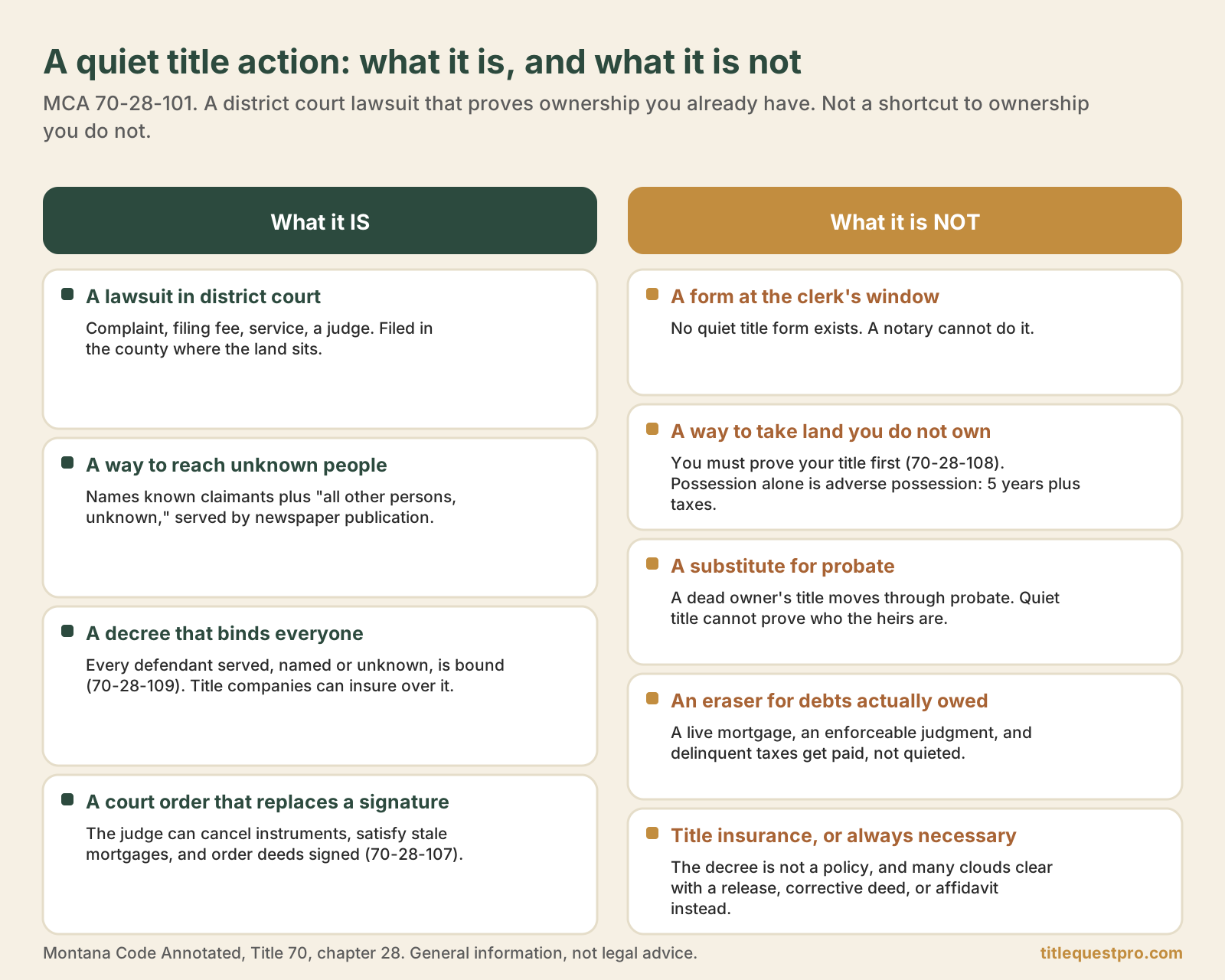
What a quiet title action is not: six assumptions that cost people months
1. It is not a form you file at the clerk's window
A quiet title action is a civil lawsuit in district court, with a complaint, a filing fee, service of process, and a judge. There is no quiet title form at the clerk and recorder's office, and a notary cannot do it. For a case with unknown defendants and publication, you want an attorney.
2. It is not a way to take land you do not own
The statute requires the plaintiff to produce "evidence sufficient to prima facie entitle the plaintiff to relief" before a decree can be entered against a defendant who never appears (MCA 70-28-108). You still have to prove your title. If your claim rests on possession rather than a deed, that is adverse possession, which in Montana requires five years of continuous occupation and payment of all taxes legally levied on the land during those years (MCA 70-19-411). The five years and the tax receipts come first.
3. It is not a substitute for probate
This is the big one for inherited property. When the record owner has died, title passed at death to the heirs or devisees under the Montana inheritance laws, but the deed still says the dead person's name. The tool that proves who the heirs are is probate, and the title company wants to see it. Suing to quiet title in your own name does not establish that your mother's estate had no creditors, that her will was valid, or that your half-brother in Spokane was not an heir.
A simple way to keep the two straight: probate answers "who gets it." Quiet title answers "who already has it." Asking a judge to quiet title before probate is asking for the trophy before the game has been scored.
Montana does give probate a three-year outside limit, and after that a personal representative can still be appointed only to confirm title in the successors (MCA 72-3-122). In old estates, an attorney may pair that with a quiet title action to clean up everything at once. But for a recent death, probate in Montana is the cheaper and faster path, and no judge will let you skip it by relabeling the case. Once letters issue, a Montana personal representative can usually sell the house without any court order at all.
4. It does not erase a lien that is actually owed
The suit clears claims that are invalid, stale, or unprovable. It does not cancel a mortgage you still owe, a judgment lien that is still enforceable, or delinquent property taxes. If the county has attached a Montana tax lien to the land, the lien gets paid or redeemed; it does not get quieted. The statute lets the court order a mortgage "satisfied," which means releasing a paid-off loan the lender never bothered to record a release for, not forgiving a live one.
A judge will tear up an IOU that was paid years ago and never thrown away. A judge will not tear up an IOU you still owe.
5. It is not title insurance
The decree says who owns the land as of the date the judge signs it. Title insurance is a policy that pays if the title turns out to be defective. The decree is the clean inspection report; the policy is the warranty you buy after the inspection. You usually need the first to get the second, and a title company may still write exceptions for things the lawsuit did not address, like an easement of record or a survey issue nobody raised.
Ask the examiner, before you file, exactly which exceptions the decree needs to remove. That one conversation shapes the whole complaint.
6. It is not always necessary
Many clouds that look fatal clear with a recorded document and no judge. An unreleased mortgage from a lender that still exists clears with a release the lender signs. A deceased joint tenant clears with a recorded affidavit of death and a death certificate. A misspelled name or a bad legal description often clears with a corrective deed from the same grantor.
The lawsuit is the tool you use when the person who could sign is gone, unknown, or refusing. If someone is reachable and willing, get the signature.
When a quiet title action is the right tool in Montana
Here is the list I check a Montana title against before I decide a cloud needs a courtroom.
- An unreleased mortgage or lien from a lender, company, or person that no longer exists or cannot be found.
- An heir on the chain of title who cannot be located, or a line of heirs that cannot be identified at all. Publication against "all other persons, unknown" is built for this.
- A stranger's deed in the chain, sometimes called a wild deed, that does not connect to the real owner.
- Overlapping or conflicting legal descriptions between neighboring deeds, where nobody can agree where the line is. The court may order a survey (70-28-113).
- A tax deed. If you hold or are buying land that came through a county tax deed, title companies generally want a court decree before they insure it. Montana has a specific procedure for this, in MCA 15-18-411 and 15-18-412, that runs alongside the ordinary quiet title rules and requires the former owner to deposit the back taxes with the court to contest it.
- Adverse possession after the five years and the tax payments are complete.
If your cloud is on that list and the person who could sign a release is unreachable, the lawsuit is probably the answer.
How a quiet title action works in Montana: the six-step path
Every Montana quiet title case I have watched follows the same shape. I call it the six-step path because knowing the steps tells you where the time goes.
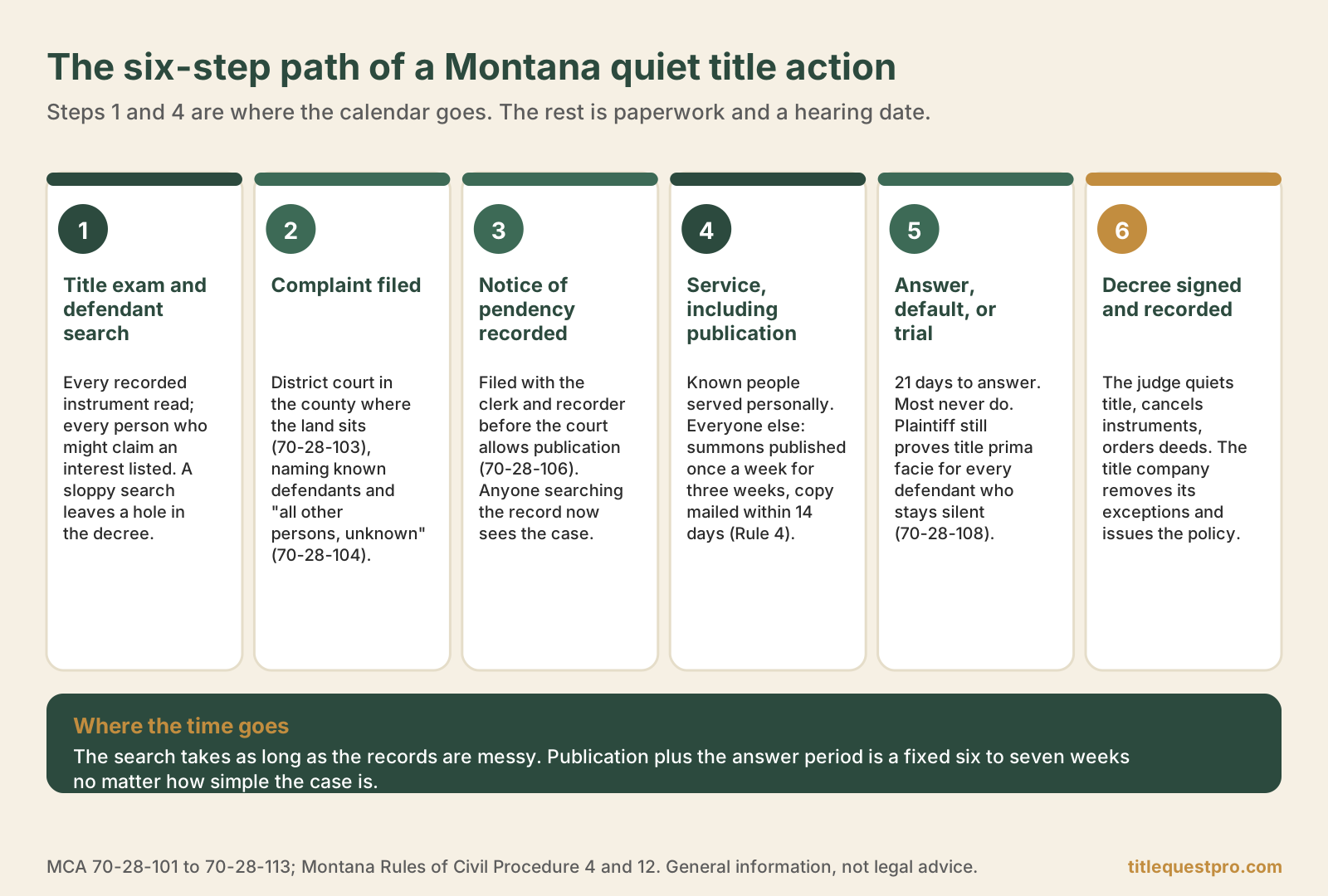
Step 1: The title examination and the search for defendants
Before anything is filed, someone reads every recorded instrument in the chain and lists every person or entity who might claim an interest: the record owner, lienholders, heirs of anyone who died in the chain, easement holders, the county if taxes are owed. Montana's publication rule requires a diligent search, and every name that can be found must be named as a defendant.
The search is the foundation of the case. Treat the defendant list like a wedding guest list where anyone who was left off can object to the marriage afterward. A sloppy one produces a decree with a hole in it.
Step 2: The complaint, filed in the county where the land sits
Venue is the county where the property is located (70-28-103). The complaint describes the land, states the plaintiff's title, names the known defendants, and adds the "all other persons, unknown" language from 70-28-104.
Step 3: Notice of pendency with the clerk and recorder
Under MCA 70-28-106, before the court will allow service by publication, the plaintiff records a notice of the pending action with the clerk and recorder in every county where the land sits. It carries the court, the case caption, a full description of the property, and the relief requested.
Step 4: Service, including publication
Known defendants with addresses get served personally or by mail.
Everyone who cannot be found, and all the unknown claimants, get served by publication under Rule 4 of the Montana Rules of Civil Procedure: the summons runs once a week for three successive weeks in a newspaper in the county, and a copy is mailed to any last known address within 14 days of the first publication. Service is complete on the date of the last publication. Those legal notices in the back of the Bozeman Daily Chronicle are quiet title summonses.
Step 5: Answer, default, or trial
A served defendant has 21 days to answer. Most never do; they are dead, dissolved, or have no claim. For every defendant who does not appear, the plaintiff still has to put on prima facie evidence of title (70-28-108), usually through the title examiner's report, the recorded deeds, and an affidavit. If a defendant does appear and contests, the case proceeds like any other civil suit, with discovery and possibly a trial.
Step 6: The decree, recorded
The judge signs a decree quieting title. It gets recorded with the clerk and recorder. The court can also order specific instruments canceled, liens satisfied, or deeds signed (70-28-107). The title company reads the decree against its exceptions, removes the ones the decree covers, and issues the policy.
What this means for you: steps 1 and 4 are where the calendar goes. The search takes as long as the records are messy, and publication plus the answer period is a fixed six to seven weeks no matter how simple the case is.
How long a quiet title action takes and what it costs
No Montana statute sets a deadline for finishing a quiet title action, so anyone quoting a fixed number is guessing. Here is what the mechanics force.
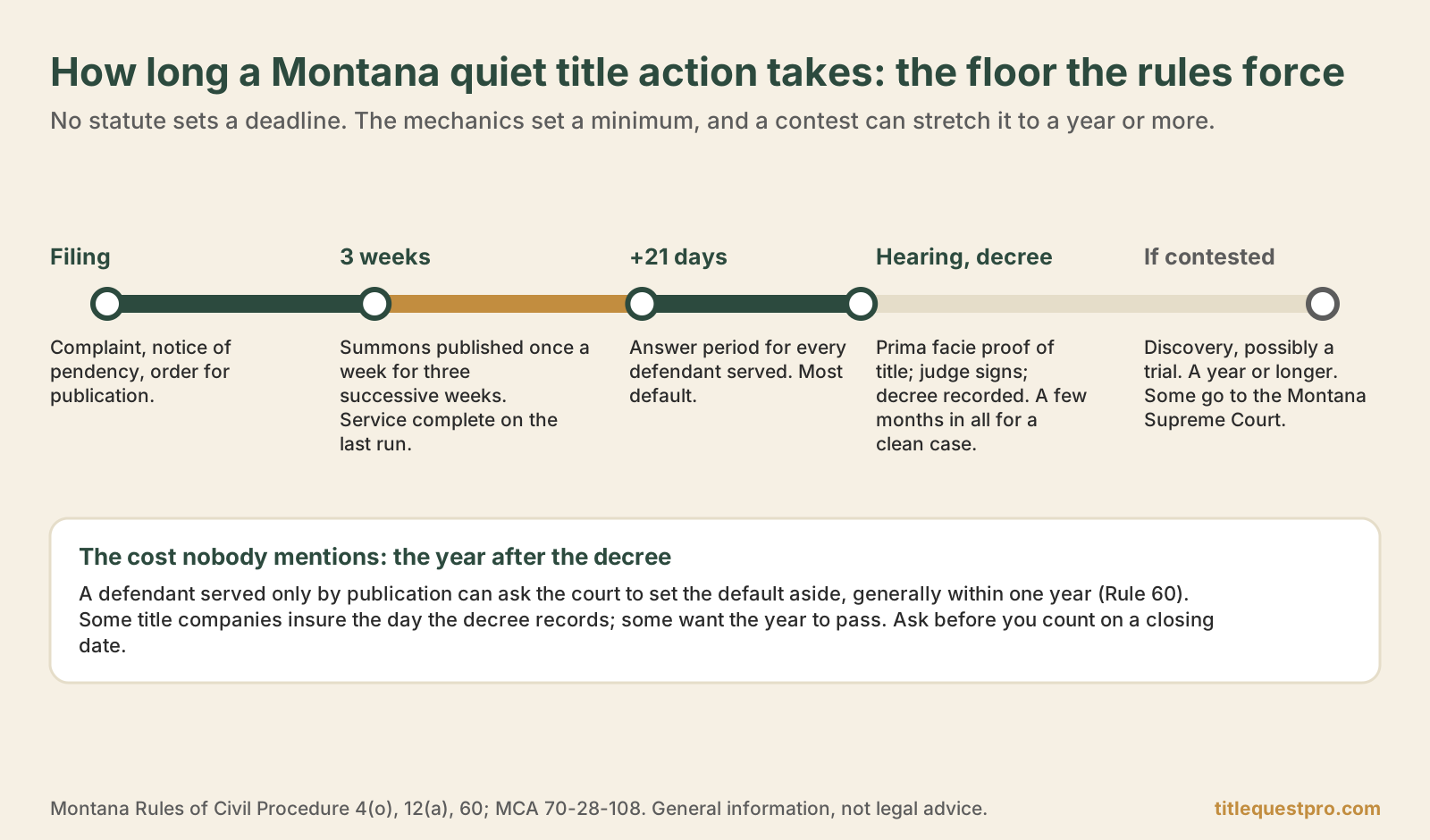
The publication period is three weeks. The answer period is 21 days from service, which is complete on the last publication date. Add the time to draft and file, get the publication order, and get a hearing date on the court's calendar.
An uncontested case with clean evidence typically runs a few months from filing to decree. A contested case, where a defendant appears and fights, can run a year or longer, and some Montana quiet title disputes go all the way to the state Supreme Court.
Cost comes in four pieces: the district court filing fee, the title report or abstract, the newspaper publication, and the attorney. The attorney is the largest line, and it scales with how many defendants there are and whether anyone contests. For a simple uncontested case, ask for a flat-fee quote.
Also know the cost rule in MCA 70-28-112: you cannot recover your costs from a defendant who disclaims any interest in the answer or who simply lets judgment be taken without answering. In practice, the plaintiff pays for a quiet title action and does not get reimbursed.
One more cost most people never hear about. A defendant served only by publication, who never saw the notice, can come back later and ask the court to set the default aside. Under Montana's Rule 60, that motion generally has to be filed within a year for ordinary grounds like excusable neglect, and within a reasonable time if the service itself was defective.
Title companies know this. It works like a purchase with a one-year return window: some stores will treat the sale as final the day you walk out, and some wait until the return period closes. Ask before you count on a closing date.
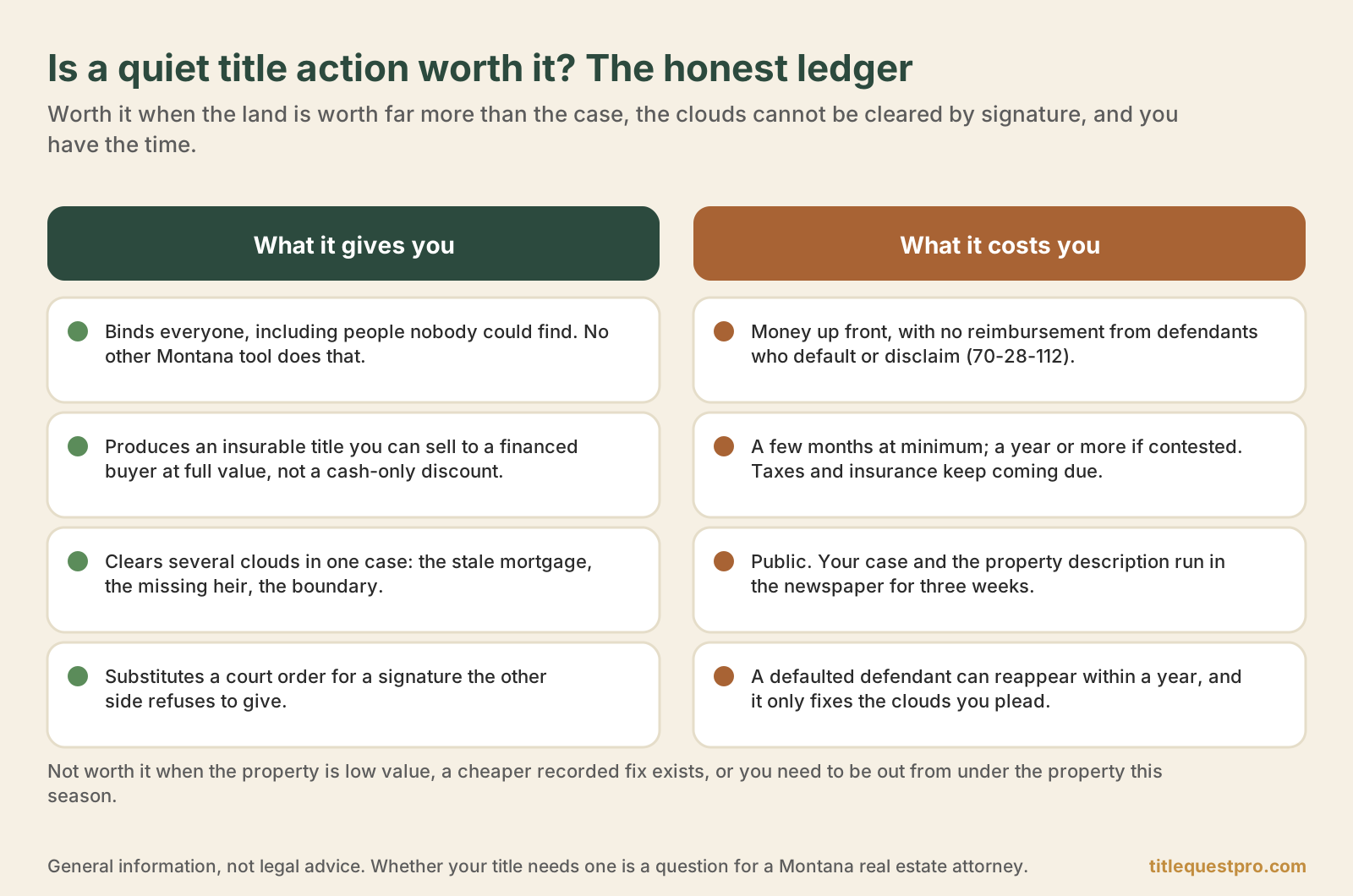
The pros and cons, plainly
What a quiet title action gives you
- A decree that binds everyone, including people nobody could find. No other Montana tool does that.
- A clean, insurable title that can be sold to a financed buyer at full market value, instead of a cash-only sale at a discount.
- A single case that can clear several clouds at once: the stale mortgage, the missing heir, and the boundary question, all in one decree.
- A court order that substitutes for a signature the other side refuses to give.
What it costs you
- Money up front with no reimbursement in the ordinary case.
- A few months at minimum, longer if contested, during which the property is tied up and the taxes and insurance keep coming due.
- Public notice. Your case and the property description run in the newspaper.
- A residual risk that a defaulted defendant reappears within the year.
- It only fixes what you plead. A cloud you did not name is still there afterward.
The honest read: a quiet title action is worth it when the land is worth considerably more than the cost of the case, when the clouds cannot be cleared by signature, and when you have the time. It is not worth it when the property is low value, when a cheaper recorded fix exists, or when you need to be out from under the property this season.
Quiet title versus the cheaper tools: a comparison
Before any Montana seller calls an attorney about a quiet title action, I run the cloud through this table. Most of the time the answer is in the right-hand column.
| The cloud | The cheaper tool to try first | When quiet title is actually needed |
|---|---|---|
| Record owner is deceased | Informal probate, or an affidavit of death for a joint tenant or TOD deed beneficiary | Only when probate is time-barred and title still needs confirming |
| Paid-off mortgage never released | A release from the lender, or its successor | Lender is dissolved or cannot be found |
| Heir cannot be located | Genealogy and a diligent search, then a deed from the heir | The heir, or the whole line, is unfindable after a real search |
| Name misspelled or bad description | Corrective deed from the same grantor | Grantor is dead or refuses |
| Delinquent taxes | Pay or redeem the lien | Never; taxes are paid, not quieted |
| Tax deed in the chain | None; the title company wants a decree | Yes, under MCA 15-18-411 and 15-18-412 |
| Boundary dispute with a neighbor | A boundary line agreement, recorded | The neighbor will not sign |
| Adverse possession claim | None | Yes, after five years of occupation and tax payment |
If the cheaper tool works, you save months and the attorney fee. If it does not, you have already done the search the lawsuit requires, and nothing is wasted.
Where TitleQuest Pro fits when the title needs a judge
Here is the situation I see most often in Montana. The family wants to sell, and the title company says the land needs a quiet title action. The heirs are in three states, nobody wants to front the cost of a lawsuit for land they have never lived on, and the property taxes are a year behind.
So the file sits, and the Montana tax lien clock keeps running.
We buy property in exactly that condition. The cloud does not have to be cleared before you sell to us, because clearing it is our job, and our cost, after closing.
Here is how it works. You tell us about the property, five minutes on the form or on a call. Our team pulls the deed, the tax history, and the full chain of title, and identifies every cloud and every person who would have to be named in a suit. That review takes one to seven days and is not billed.
We send a written cash offer within 48 hours of the review, laid out in email with the price and closing date. The offer is net to you: we pay the closing costs, the back taxes, and whatever curative work the title needs afterward, whether that is a release, a probate, or the lawsuit itself.
You decide. If a cheaper fix exists and a listing would net you more, I will tell you so, because I would rather you make the right decision than the one that helps me. There is one more thing our team checks on every clouded Montana title before we make an offer, and it is the thing that decides whether the cloud is a courtroom problem or a two-page fix. I will walk you through it on the call.
The offer has no deadline and no fee.
Tell us about the property or call (406) 920-1095. The whole process is on how it works; the Montana version is on clear title for inherited property.
Questions I hear about quiet title in Montana
A quiet title action is a lawsuit in district court asking a judge to decide who owns a piece of real property and to eliminate any adverse claim, lien, or cloud on the title. In Montana it is authorized by MCA 70-28-101. The plaintiff can name known claimants and all unknown persons, and the final decree binds everyone served. It is used when a cloud cannot be cleared by a signed release, deed, or probate.
No statute sets a deadline. The mechanics force a floor: three weeks of newspaper publication, then 21 days for defendants to answer, plus drafting, the publication order, and a hearing date. An uncontested Montana case with clean evidence usually runs a few months from filing to decree. A contested case can take a year or more, and the decree can be challenged by a defaulted defendant for up to a year afterward.
The cost has four parts: the district court filing fee, a title report or abstract, newspaper publication for three weeks, and attorney fees, which are the largest piece and scale with the number of defendants and whether anyone contests. Under MCA 70-28-112, the plaintiff generally cannot recover costs from a defendant who disclaims or defaults, so plan to pay the full amount without reimbursement.
Usually no. When the record owner has died, title passed to the heirs at death, but proving who the heirs are and that creditors were handled is what probate does, and Montana title companies want to see it. Probate is also cheaper and faster than a lawsuit for a recent death. A quiet title action gets paired with probate mainly in old estates where the three-year probate limit under MCA 72-3-122 has passed and title still needs confirming.
Only if the debt is not actually owed. A court can order a paid-off mortgage satisfied when the lender never recorded a release, and it can cancel invalid or stale liens. It cannot forgive a live mortgage, an enforceable judgment lien, or delinquent property taxes. A Montana tax lien is cleared by paying or redeeming it, and a tax deed holder has a separate quiet title procedure under MCA 15-18-411.
Yes, in limited cases. A defendant who was served only by publication and never appeared can ask the court to set the default aside. Under Montana's Rule 60, most grounds must be raised within a year of the judgment, and a judgment entered on defective service can be attacked within a reasonable time. That residual risk is why some title companies wait before insuring a freshly quieted title.
The bottom line
A quiet title action is the court's way of saying who owns the land and erasing every claim that cannot be proven. In Montana it is a district court case under Title 70, chapter 28, with publication against unknown claimants and a decree that binds the world. It is powerful, and for a lost heir, a dissolved lender, a tax deed, or a boundary nobody will agree on, it is the only tool that works.
It is also expensive, slow, public, and only as good as the search behind it. Before you file, run the cloud through the table above and try the signature first. A release, a corrective deed, or an informal probate clears most Montana titles for a fraction of the cost.
TitleQuest Pro is not a law firm. This is general information drawn from the Montana Code Annotated and the Montana Rules of Civil Procedure, not legal advice. Whether your title needs one is a question for a Montana real estate attorney or your title company.
If the title company has already said the words and you would rather sell than sue, tell us about the property. I read every message myself.

Daniel Bear
Founder, TitleQuest Pro
Daniel has been in real estate since 2016 and today buys inherited houses and untangles the titles other buyers won't touch. He works from Bozeman, Montana, with one foot in Montana and the other on the ground in Texas. TitleQuest Pro is not a law firm; this is general information, not legal advice.
Related reading.
Sell your share of inherited property
Sell your fractional interest without convincing the rest of the family.
Sell your share of inherited property →Sell a house with a tax lien
We close on Texas houses with active tax suits.
Sell a house with a tax lien →Clear title on inherited property
How to clear clouded title on inherited Texas property.
Clear title on inherited property →Ready when you are.
When you're ready to talk, we're here. Fill out the form, give us a call, or book a 15-minute conversation with Daniel. We'll handle the next step.
Tell us about the property.
We'll review it. We'll call you back within 24 hours. No pressure, no fees, no obligation.