Texas
What Happens When You Inherit a House: The Five Realities
By Daniel Bear · Texas · July 22, 2026
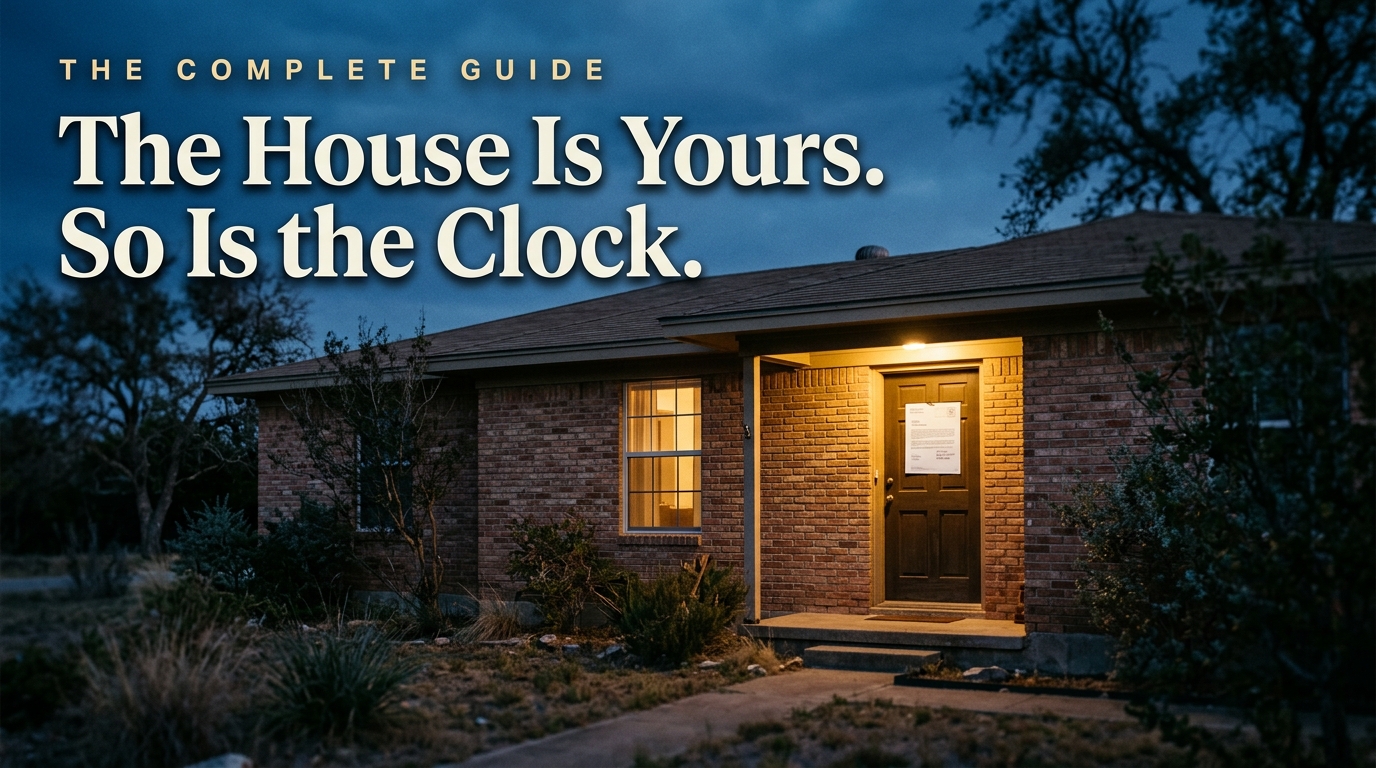
The calls that built my company almost all start the same way. Someone's mother or uncle or grandfather died owning a house in Texas, time has passed, and the family still doesn't know what they own, what they owe, or who is supposed to act. If you're asking what happens when you inherit a house, you're already ahead of most of the families I meet. Most don't ask until a county lawsuit forces the question.
I've spent years on the phone with heirs in exactly your spot, so this is the full map of what happens when you inherit a house: what the law does the instant an owner dies, the five realities that follow, and every path out, including the one nobody chooses on purpose. Near the end is the story I tell every family tempted to wait, about how an expected $10,000 per heir became $2,800.
Quick answer: what happens when you inherit a house in Texas is that ownership passes to the heirs immediately at death, subject to the estate's debts, under Texas Estates Code Section 101.001. But the deed, the property taxes, and the county records don't update themselves. Someone has to act, and waiting is the most expensive choice a family can make.
The Legal Moment: What Happens When You Inherit a House in Texas
Start with the part almost nobody believes when I say it on the phone: you may already own the house. Right now. No court date required.
Under Texas Estates Code Section 101.001, a deceased owner's estate vests immediately in the heirs at death. With a valid will, the property vests in the people named in it. Without one, it vests in the heirs at law the moment the owner dies. Either way, the statute says immediately.
There's a catch riding along, and it matters. That same law makes your ownership subject to the estate's debts under Section 101.051. You own the house, and the house still owes what it owed. Back taxes, liens, and the mortgage all survive the funeral.
So who are the heirs? With no will, Texas intestate succession rules decide, not the family's memory of what Dad promised. Generally the spouse and children split it, and a deceased child's share drops down to that child's own kids. The family tree is the ownership chart, whether anyone has drawn it or not.
I work Texas and Montana, and I'll flag it plainly: this post is Texas law. Montana runs its own probate system on different timelines, but the pattern of what happens when you inherit a house is the same in both states. If your inherited property sits near me in the Bozeman area instead of Dallas, the realities below still apply; the statutes and deadlines change.
That's the clean legal answer to what happens when you inherit a house. Now here's what actually happens, which is messier.
The Five Realities of an Inherited House
Every stuck estate I've ever bought into, and I've bought into a lot of them, got stuck on one of the same five realities. I call them the Five Realities, and together they're the honest version of what happens when you inherit a house once the statute has done its work. I walk families through them in this exact order on the phone. The fourth one is the one that shocks people, and it's the reason I have a job.
No. 01: The deed doesn't change itself
The law made you an owner. The paper didn't get the message.
The county deed records still show the person who died, and they will keep showing that name for decades if nobody acts. Nothing transfers automatically. Not the will sitting in a drawer, not the funeral, not time.
Until the record catches up, no title company will insure a sale, which means no normal buyer can buy and no bank will lend. The house is yours in theory and stuck in practice. If there's a will, probate moves the title. If there isn't, many Texas families use an affidavit of heirship, a recorded document that lays out the family tree, signed by two witnesses who knew the family but don't inherit.
I've watched a family go three generations without moving title once. The grandkids found out when the county served them with a lawsuit.
On paper, that's what happens when you inherit a house: nothing, until somebody makes it move.
No. 02: The tax clock starts the day the owner dies
The tax clock is the piece of what happens when you inherit a house that nobody warns families about. Property taxes don't pause for grief, and they usually go up right when the family expects them to stay flat.
Here's why. A homestead exemption and an over-65 tax ceiling belong to the owner, not the house. Per the Texas Comptroller, those protections end at death for everyone except a surviving spouse who is 55 or older. The kids don't inherit the frozen bill. The next statement can land at a number your parent never paid in their life.
Here's the half of that story almost nobody tells heirs, and it changes what happens when you inherit a house you plan to live in. Texas lets you file for your own homestead exemption as an heir property owner, even with no deed in your name and even if you only own a share, and you get the full exemption, not a fraction of it. If you're 65 or older or disabled yourself, you can claim that exemption in your own right too, with a new tax ceiling at your level.
There's an even stronger protection behind that one. A 65-plus or disabled heir living in the home can file a tax deferral affidavit under Tax Code 33.06 that pauses collection, and pauses a pending tax suit or tax sale, for as long as they own and live in the house, with interest slowed to 5 percent a year. None of that erases what went unpaid before you filed. It changes what happens next.
Miss that bigger bill and Texas is not gentle. Under Tax Code Section 33.01, a delinquent balance takes a 6 percent penalty the first month, climbs to 12 percent by July, and collects 1 percent interest monthly on top, before the county's collection law firm adds its fees. I've told heirs what one told me: they stack up fast.
Two estates from my own files, names left out: one hit roughly $42,000 in back taxes with a tax sale expected within weeks, another sits around $23,000 with a trial date already on the court's calendar. Both started as a normal tax bill mailed to a dead person's address.
No. 03: The debt belongs to the property, not to you
This is the fear I defuse on almost every call, so let me defuse it here. Part of what happens when you inherit a house is that the old debts show up with it, but they do not become your personal debts.
The back taxes, the liens, the judgments against the person who died, even the mortgage: those are claims against the property and the estate. Nobody can garnish your wages or empty your savings over your father's tax bill. The county's tax lawsuit names heirs as defendants because they own the property now, not because anyone is coming for their wallets.
The real risk points the other way. The debt eats the asset while everyone freezes. Penalties compound, the suit moves on the court's calendar, and a house with real equity slowly becomes a house with none.
The exceptions are narrow: debts you co-signed, certain debts between spouses, and your own personal liens, which can attach to the share you inherit. Everything else gets paid out of the property, usually at closing when it sells.
No. 04: The heirs multiply every year nobody acts
Here's the reality that turns a two-signature problem into a family reunion of strangers.
When an heir dies before the estate gets resolved, their share doesn't disappear. It splits again, down to their own heirs. Wait long enough and the ownership chart stops looking like a family and starts looking like a phone book.
The worst I've personally worked: a Dallas County house where seven siblings became roughly 18 interest holders once a deceased brother's descendants were counted. Some held shares as small as about 1/45th. Some had never met the Texas side of the family. One brother hadn't been heard from in fifty years, and his signature still mattered as much as anyone's.
Every one of those people is a defendant when the county sues. Every one has to sign before a title company will touch a full sale. That's what happens when you inherit a house and the family waits a generation: the decision that needed three people now needs eighteen.
No. 05: The condition and the occupants set your options
The last reality is physical. What shape the house is in, and who's living in it, decides which paths are actually open to you.
A vacant house bleeds quietly. Insurance policies commonly limit coverage once a home sits empty for a month or two, pipes burst with nobody watching, and empty houses attract visitors. We've bought houses that needed thousands of dollars of cleanout before anyone could stand in the kitchen.
An occupied house is more complicated, especially when the occupant is family. An heir living in the house is still an heir. Her share is her share, she has to sign like everyone else, and if she's over 65 or on disability, a tax deferral can legally freeze the county's clock for her while every other heir's equity stays trapped. I've seen that exact standoff hold a family in place for five years.
Neither situation is hopeless. Both change the math, the timeline, and who will buy. Condition and occupancy are the part of what happens when you inherit a house that no statute mentions, and they matter as much as the law does. Walk the property early, insure it honestly, and be realistic about the people in it.
Those are the five. Now let me show you where your specific version of this lives, because I've written a full guide for each one.
The Guided Tour: Which Version of This Is Yours?
This page is the hub. Each branch below is its own deep guide, and each one goes further than I can here. Find your situation and go read your chapter of what happens when you inherit a house.
If the house came with debt attached
The letters are usually what start the panic: a tax statement in a dead person's name, a collection notice, a citation from a law firm you've never heard of. My guide to inheriting a house with debt is the calm walkthrough I wish every heir got in the mail first.
It covers the rule that matters most, which is that the debt attaches to the property and the estate rather than to you personally, and the short list of exceptions where that isn't true. It walks the full back-tax snowball, from missed bill to lawsuit to judgment to courthouse auction, including the payment-plan myth a county collection firm confirmed to us directly: payment plans generally don't exist until after judgment.
Then it gets practical with my three-question debt triage. Is the debt attached to the property or to you? How far along is the county? Is there equity left after the debt?
Those three answers sort nearly every situation I see into fight, sell, or walk away. If debt is the loudest part of what happens when you inherit a house in your family, start there.
If there's still a mortgage on it
The mortgage statement keeps arriving with your parent's name on it, and nobody tells you whether to pay it, call the bank, or hide. My guide to inheriting a house with a mortgage covers what happens when you inherit a house the bank still has a lien on, with the actual federal rules cited so you can check me.
The short version: the loan survives the owner, but it doesn't become your personal debt. A federal law called the Garn-St Germain Act blocks the lender from calling the loan due just because a relative inherited, so an heir can usually step in and keep paying at the existing rate. Federal servicing rules also force the mortgage company to deal with you once you're confirmed as a successor in interest, instead of stonewalling you about "someone else's account."
The guide walks your four choices, keep paying, formally assume, sell, or walk away, plus the two clocks that punish drift: reverse mortgages that come due at death, and a Texas foreclosure process that can legally run in about 41 days. If payments already stopped, read it this week, not this month.
If the house is paid off
Free and clear sounds like the finish line. In truth, what happens when you inherit a house that is paid off is the slowest, quietest kind of trouble, because nothing forces anyone to act. Most of the houses my company buys are paid off. The mortgage was never the problem on those files; the silence was.
My guide to inheriting a house that is paid off covers the three things that keep moving while the family doesn't: the title that still says a dead person's name, the tax bill that jumps when the exemptions expire, and the insurance that quietly stops covering a vacant house after a month or two.
It also carries the best tax news in this whole cluster, the step-up in basis. Your capital gains basis resets to the home's value at the owner's death, which means selling reasonably soon often means little or no capital gains tax.
The same guide includes my four-question paid-off house test, which tells you in one evening whether keep, rent, or sell fits your family. Plenty of people who run it should keep the house and never call a buyer like me. The guide says so plainly.
If it's your parents' house
Everything above gets heavier when the property is the house you grew up in. Nothing changes what happens when you inherit a house quite like having your own childhood inside it. This is grief plus money plus siblings pulling on one address, and it deserves better than spreadsheet advice.
My guide to inheriting your parents' house is the one I'd mail to every family in month one. It runs on a simple frame: there is no rush on the decision, and there is a clock on the paperwork, and most families get in trouble by mixing those up. It gives you the 30-day grace plan, five protective moves in month one, so you can grieve without the county gaining on you, and it names what can genuinely wait, including the cleanout, which on my own deals has run from about $2,663 to nearly $10,000.
It also handles the two hardest sibling problems honestly: the sister living in the house rent free, where sympathy and math are both real, and the verbal promise everyone remembers. "He was leaving it to her" is a sentence I've heard from multiple families. A promise is not a will, and a will is not a deed.
If you just want to know what to do first
Maybe none of the labels above fit yet. You just know that someone died, there's a house, and you're the one typing questions into a phone at 1 a.m. My guide I inherited a house, now what is the checklist version of what happens when you inherit a house: seven steps, first 14 days, in order.
Death certificate and will first. Then pull the deed, check the tax status, and open every piece of mail, because tax suits go unanswered not from stubbornness but from envelopes nobody opens. Then map the heirs, secure and insure the house, and only then decide keep, rent, or sell. The order is the point, because deciding first and checking later is how heirs lose money.
That guide also names the three most expensive mistakes I watch heirs make, including paying taxes on a house that isn't titled to you yet, which one heir summed up better than I ever have: why would I pay up the taxes and not own the property? At that point it's a gift to every cousin who never calls back.
The Paths Forward: Keep, Rent, Sell, or Sell Your Share
Once you know your situation, what happens when you inherit a house comes down to five paths. Four are choices. The fifth is what happens when you don't choose.
Keep it
Keeping it is the right answer more often than a house buyer should admit, and it's the best version of what happens when you inherit a house you actually want. It works when someone actually wants the house, can carry the new tax bill without the old exemptions, and the other heirs are genuinely settled, ideally bought out in writing. The homework is real but finite: move the title, file your own exemptions, insure it for how it's really used.
Rent it
A paid-off inherited house can be a solid rental, and Dallas-area houses like the ones I work on rent all day long. Just go in with eyes open: every co-heir shares the rent, the repairs, and the 2 a.m. phone calls, and the title work still has to happen first. A rental nobody formally owns is a problem wearing a cash-flow costume.
Sell the whole house
The clean exit when the family agrees. With clear title you can sell retail, and thanks to the step-up in basis the tax bill on the sale is often small. The obstacle is rarely the market; it's signatures, because every heir generally has to sign, and one holdout can stall the entire estate. I've watched a full-price cash sale die at the table because one relative refused to sign at the last minute.
Sell your share
The path most heirs don't know exists. In Texas you can sell your individual heir interest without the rest of the family's permission. Your share is your share. A fractional interest is hard to sell on the open market, but specialists like my company buy individual heir interests as-is, which lets one exhausted heir be finished while the others keep every option they had.
Do nothing, and what it costs
Now the fifth path, the default one, and the story I promised at the top. This is what happens when you inherit a house and nobody acts.
A Dallas-area family came to me years into exactly this. The owner had died without a will. A relative moved into the house, the taxes went unpaid, and the family waited for a consensus that never arrived.
By the time we talked, the estate had been in probate almost four years across two different attorneys, the first paid well before quitting. Back taxes had climbed to somewhere between $40,000 and $45,000. Ownership had splintered to about 18 people.
Early on, the heirs expected around $10,000 each from the house. Four years later the realistic number was about $2,800. Nobody stole it. Penalties, interest, and hourly fees ate it while everyone waited for someone else to move.
And doing nothing has an ending. The county files suit, judgment enters, and the house sells at auction on the courthouse steps, usually for far less than it's worth.
Anything left over doesn't just get mailed to the family; claiming excess proceeds is its own court process, and most families need an attorney to see a dollar of it. Getting it back afterward costs the winning bid plus a 25 percent penalty in the first redemption year, 50 percent in the second. Doing nothing isn't neutral; it's the most expensive plan on this page, chosen by accident.
How I'd Tell You to Choose
I buy inherited property for a living, so weigh my advice accordingly. But this is how I talk through what happens when you inherit a house and have to choose, including with the people who shouldn't sell to me.
If the house has real equity and the family can cooperate, protect the equity. I once told an executor holding a $200,000 offer on a house with about $45,000 of back taxes not to panic-sell over the tax debt, even though her selling cheap would have been my gain. When the numbers are real, pay the debt at closing out of the proceeds and sell it right, or keep it and make it a home again.
If one heir loves the house and can carry it, let them, formally. Buyouts in writing, title moved, exemptions refiled. A grandchild growing up with the same door frame is a better ending than any check.
If the estate is tangled, the family is scattered, and the taxes are climbing, be honest about whether consensus is ever coming. Selling the whole house, or just your share, isn't giving up. It's choosing an ending on purpose instead of letting the county choose one for you.
Somebody asked me once what my company actually is, and the answer I gave has three parts. A lighthouse, when a family just needs to see the whole board clearly, which is what this guide is for. A life raft, when the tax suit clock is running and someone needs out now. And a cleanup crew, because that's literally the work: we come in, fix the title problems, handle the liens and back taxes, and let the heirs who want to walk away breathe.
You may only ever need the lighthouse. That's fine with me.
Questions People Ask About What Happens When You Inherit a House
Ownership still passes immediately. Under Texas Estates Code Section 101.001, an intestate estate vests in the heirs at law the moment the owner dies, with the shares set by Texas intestacy rules, generally the spouse and children. What's missing is proof: until the family records an affidavit of heirship or completes probate, the deed still shows the deceased owner and no title company will insure a sale.
Not always. If there's a valid will, it generally must be admitted to probate within four years for the title to move, and some estates qualify for faster lanes like muniment of title. Many Texas families with no will skip full probate and document ownership with an affidavit of heirship, signed by two disinterested witnesses and recorded with the county. Which lane fits depends on the estate, so a short conversation with a probate attorney is worth it.
They keep billing, and usually rise, because the exemptions end at the owner's death for everyone except a surviving spouse who is 55 or older. An heir who moves in can file for their own exemptions under the heir property rules, including over-65 or disability if they qualify. Missed bills compound monthly under Texas Tax Code 33.01, and enough delinquency triggers a county lawsuit naming every heir. Check the balance on the county tax site in week one.
Not personally, in almost every case. Back taxes, liens, and the mortgage attach to the property and the estate, and they get paid from the property, usually at closing when it sells. Your own wages and savings are not on the hook for a deceased owner's debts unless you co-signed or certain spousal rules apply. The danger is different: unpaid debt compounds against the house itself until the equity is gone.
Yes. Texas lets you sell your individual heir interest without the other heirs' signatures or consent. That matters most in stuck estates where the family can't agree, because it means one heir can exit while the rest keep their options. Open-market buyers rarely want fractional interests, but companies that specialize in heir property buy them as-is and handle the title work and back taxes at closing.
The quiet costs take over. The exemptions expire and the tax bill rises, penalties and interest compound monthly, the insurance lapses on a vacant house, and each family death splits ownership among more heirs. Eventually the county files a tax suit, and an ignored suit ends with judgment and a courthouse auction. I watched one family's expected payout fall from about $10,000 per heir to about $2,800 over four years of exactly this.
The House Won't Decide. You Will.
Here's this whole map folded small. What happens when you inherit a house in Texas is that the law hands you ownership instantly, then hands you five realities: a deed that won't move itself, a tax clock already running, debt that belongs to the property, a family tree that keeps branching, and a house whose condition narrows your options every season it sits.
None of that is a crisis if someone acts. All of it becomes one if nobody does.
So find your chapter above, run the checklists, and make the keep, rent, or sell call out loud, as a family, while every option is still open. Grief deserves time. The county won't give it any. Somebody has to stand between those two facts, and it might as well be you.
And When You Want Help, This Is What We Do
TitleQuest Pro buys inherited houses and individual heir interests as-is in Texas and Montana. The tangled files are our specialty: back taxes, active tax suits, deeds still in a grandparent's name, eighteen heirs scattered across ten states.
The mechanism is simple. My team pulls the title, tax history, and heirship chain in-house, so you never pay to find out where you stand. Back taxes and liens get handled at closing out of our money, not yours.
A mobile notary comes to you, whatever state you live in. And our written offer arrives within 48 hours of review and never expires, because pressure isn't how we work.
There's one more step in our process I haven't named here. Sellers tell us it's the part that surprised them most. Ask me about it on the call.
We've taken titles through this start to finish that no title company would touch, curative work included, in a matter of months. That's the job: we make the mess our problem instead of yours.
If you inherited a house, or just a share of one, and you want a real number and a real answer, tell us about the property or book a 15-minute call with me. No fees. No obligation. You can say yes, you can say no, or you can sit with it for a month. Now you know what happens when you inherit a house. What happens next is up to you.
TitleQuest Pro is not a law firm and this isn't legal advice. Every situation is different. If you need legal guidance, talk to a Texas probate or real estate attorney.

Daniel Bear
Founder, TitleQuest Pro
Daniel has been in real estate since 2016 and today buys inherited houses and untangles the titles other buyers won't touch. He works from Bozeman, Montana, with one foot in Montana and the other on the ground in Texas. TitleQuest Pro is not a law firm; this is general information, not legal advice.
Related reading.
I inherited a house, now what
The seven-step, first-14-days checklist, in order.
I inherited a house, now what →Inheriting a house with debt
Most inherited debt belongs to the property, not to you. Here's what does and doesn't.
Inheriting a house with debt →Inheriting a house with a mortgage
The loan doesn't die with the owner, and federal law protects heirs. What to ask first.
Inheriting a house with a mortgage →Ready when you are.
When you're ready to talk, we're here. Fill out the form, give us a call, or book a 15-minute conversation with Daniel. We'll handle the next step.
Tell us about the property.
We'll review it. We'll call you back within 24 hours. No pressure, no fees, no obligation.