Texas
Affidavit of Heirship Form Texas: How to Fill It Out Right
By Daniel Bear · Texas · June 21, 2026
By Daniel Bear, founder of TitleQuest Pro. He has been in real estate since 2016 and pays for the curative title work himself.
You went looking for an affidavit of heirship form Texas accepts. You downloaded a blank PDF. Then you stared at it.
Half the boxes use words nobody explained. The other half ask about family history you are not sure you remember right. A title company told you to "get an affidavit of heirship" and handed you nothing else.
That is where most families are when they call me. The form is not the hard part. The facts you put on it are.
Get those facts right and a Texas property sale that felt stuck can move in a few weeks. Get them wrong and you can record a document a title company quietly refuses to insure. Here is how the form actually works, section by section, in plain language.
Quick answer: An affidavit of heirship form Texas heirs use is a sworn, notarized statement recorded in the county deed records that names a deceased owner's heirs and lays out the family history. It documents who inherited when there was no probate. The form is short. The five facts and the two witnesses behind it are what make it hold up.
Where to Get a Real Affidavit of Heirship Form Texas Will Record
You have a few sources, and they are not equal.
County or title-company versions are the safest starting point. Many Texas title companies keep their own preferred affidavit of heirship template Texas closers will actually accept. They are the ones who have to insure the sale, so their version reflects what they need to see. If you know which title company is handling the closing, ask them for their form first.
A generic Texas affidavit of heirship PDF off a legal-forms site is usually fine in structure. The risk is not the layout. The risk is that a blank form gives you no help with the part that matters: getting the family history complete and correct.
The Texas Estates Code sets out what an affidavit of heirship is supposed to contain, and recording happens at the county clerk's office where the property sits. So any honest version of the form follows the same bones, no matter whose logo sits at the top.
What this means for you: do not spend a week hunting for the perfect form. Almost any complete one works. Spend that week getting the facts and the witnesses lined up instead. The document you can fix in an afternoon; the family history and the witnesses take real time and care.
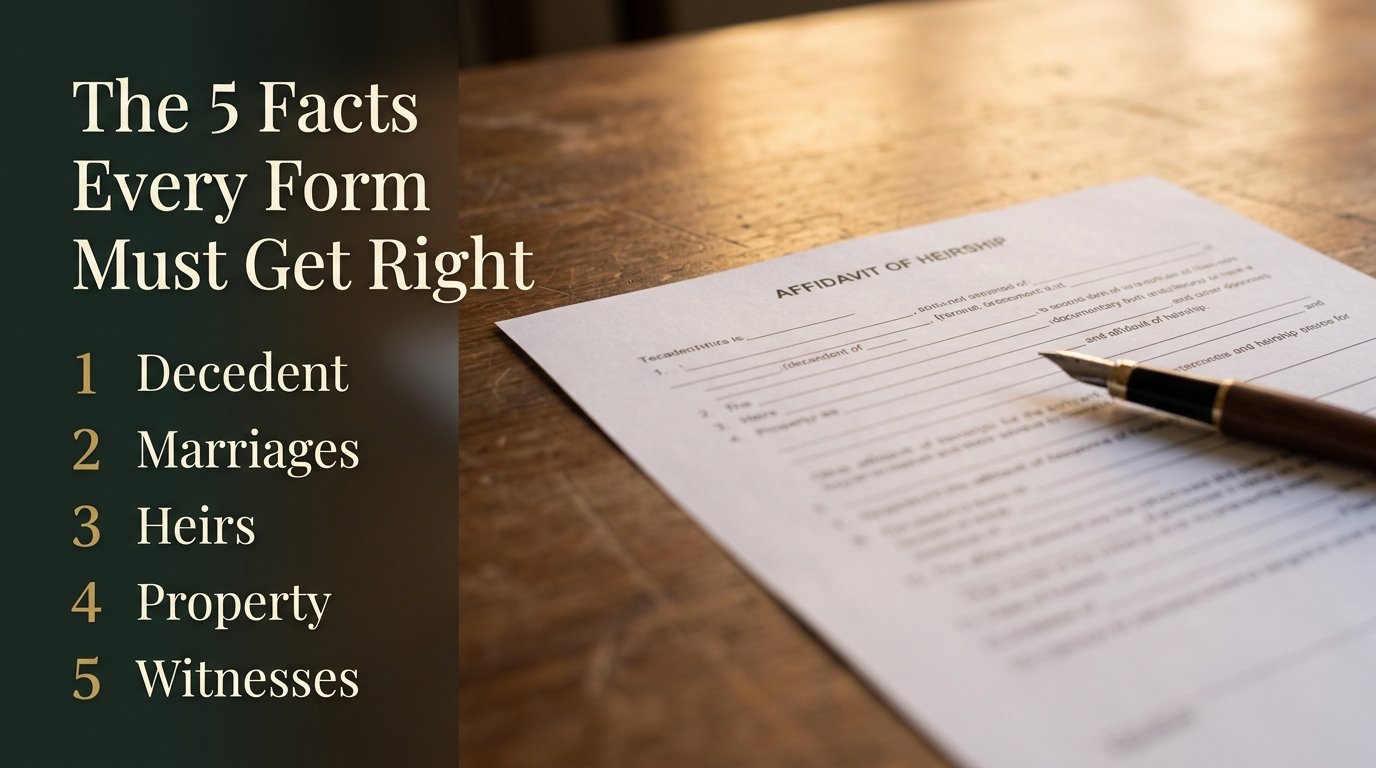
The Five Facts a Texas Affidavit of Heirship Form Has to Get Right
Every version of the form is really asking for five things. I call them the five facts. If any one of them is wrong or missing, the whole document wobbles.
1. The decedent
Who died, when, and where they lived. The form wants the full legal name of the deceased owner, the date of death, and their county of residence. Use the name exactly as it appears on the deed, even if it is a maiden name or a version nobody used day to day.
2. The marital history
Every marriage, in order, with dates and how each one ended. Death, divorce, or still married at the time. This section trips people up.
Second marriages and old divorces change who the heirs are under Texas law. Leaving one out is one of the most common reasons a title company sends the affidavit back.
3. The children and heirs
Every child of the decedent, living or deceased, from every relationship. Adopted children count. A child who died before the parent, but who left children of their own, passes a share down to those grandchildren. The form is mapping a family tree, so a missing branch is a missing heir.
4. The property
The legal description of the property, not just the street address. Pull this from the existing deed or the county appraisal record. A street address alone is not enough for the deed records.
5. The witnesses
Two people who knew the family and who do not inherit anything. More on why they matter below, because this is the box the blank form cannot fill in for you.
What this means for you: before you write a word on the form, get these five facts straight on a separate sheet. The form becomes easy once the facts are solid.
How to Fill Out the Affidavit of Heirship Form, Step by Step
Here is the order I walk families through.
First, gather your proof. The death certificate, the existing deed, and the county appraisal record. These three documents give you the name, the date, the legal description, and a starting point for the family history.
Second, build the family tree on paper. Marriages in order. Children from each. Anyone who died and who they left behind.
Do this before you touch the form, because the form just transcribes what you already worked out.
Third, fill in the five facts. Decedent, marital history, children and heirs, property, witnesses. Plain and complete. If you are unsure about a date, find it rather than guess, because a sworn statement with a wrong date is worse than a blank one.
Fourth, line up your two witnesses and get the document notarized. The witnesses sign under oath in front of a notary.
Fifth, record it. Take the signed, notarized affidavit to the county clerk in the county where the property sits and record it in the deed records. There is a small recording fee. Once it is on record, it becomes part of the property's permanent history.
Want the longer version of that last stretch, with the filing mechanics and the fees? Read our walkthrough on how to file an affidavit of heirship in Texas. For the full checklist of what the state and title companies expect, see the Texas affidavit of heirship requirements.
The Two Witnesses Are the Part the Form Can't Fill In for You
This is the section I wish every blank affidavit of heirship template Texas families download came with a warning about.
The form asks for two disinterested witnesses. Disinterested means they inherit nothing and have no financial stake in the property. It does not mean strangers.
The whole point is the opposite. You want two people who knew the family well enough to swear, under oath, that the history on the page is true.
Two honest neighbors who knew the family for decades are the heart of the document. An old family friend works. A long-time church member works.
Someone who can say, "I knew Mr. Johnson for thirty years, I knew his wife, I knew all four of his kids, and this is right."
A title company leans on those witnesses more than almost anything else on the page. The signatures of two credible, disinterested people who knew the family are what turn a piece of paper into evidence a stranger will rely on.
What this means for you: the hardest box on the form is not legal at all. It is finding two people, still living and willing, who knew your family. Start that search early.
Where the Affidavit of Heirship Form Falls Short
I will tell you the same thing I tell sellers on the phone, even when it means we do not buy anything. The form is not always enough.
An affidavit of heirship shines when the estate is simple. No will, or a will nobody probated. A known family tree. Heirs who are alive, findable, and on speaking terms, with no major debts against the estate.
In that situation, many Texas inherited-property sales close on a well-prepared affidavit and nothing else.
It falls short when heirs are missing or in conflict. When the family history has gaps no living witness can swear to. When there are competing claims, or when the chain of title has other breaks.
Those situations call for stronger tools. A muniment of title if there is a valid will. A court determination of heirship. Sometimes a full probate.
What this means for you: if your situation is clean, this form may be the only document between you and a sale. If it is not clean, do not force it. Forcing the wrong tool onto a messy estate wastes months.
What It Costs, and What We Handle
The affidavit itself is one of the cheapest documents in Texas real estate. Preparing and recording one typically runs a few hundred dollars or less. A full probate often starts in the thousands. Cost is rarely the reason to skip this step.
When we buy an inherited Texas property, the curative work, including affidavits where they fit, is our job and our expense. Our team runs the genealogy and chain-of-title research, the same work you would otherwise do alone with a blank form. We pull the deed, check the tax history, and map the family tree. That is the part most buyers skip, and it is the part that makes the rest of the deal real.
You do not have to sell to us to use any of this. Take the five facts, take the witness rule, and go file your own affidavit. If it turns out your situation is one of the messy ones, that is exactly when it helps to have someone who handles title problems for a living.
Does the Form Work the Moment You Record It?
This is the question heirs ask me most, right after they finish the paperwork. The honest answer has two parts.
Legally, title to a deceased person's Texas property passes to the heirs at the moment of death. The affidavit does not move title. It documents who those heirs already are. Think of it as the missing paperwork for something that already happened.
Practically, a title company decides how much weight to give the affidavit. Many like to see one that has been on record for a while, because a recorded affidavit of heirship gains credibility the longer it sits unchallenged in the public record. Texas law has long treated an aged, recorded affidavit as stronger evidence of heirship over time.
So a fresh affidavit can support a sale right away in a clean estate. In a thinner case, a title company may want it seasoned, or may want a second affidavit from a different witness. Each company reviews the facts on their own terms.
What this means for you: record the affidavit as early as you can, even if a sale is months off. Time on record only helps. If you are weighing this form against a small estate affidavit or probate, our breakdown of the Texas affidavit of heirship requirements lays out which path fits which estate.
Frequently Asked About the Affidavit of Heirship Form in Texas
Yes. A free Texas affidavit of heirship PDF is available from many legal-form sites and sometimes from the county. A free form is fine to start with. Just remember the document only works if the family history is complete and two disinterested witnesses sign it. The blank form is the easy part.
Yes. The form has to be signed under oath before a notary, and the two witnesses are notarized as well. A notarized signature is what lets the county clerk record it in the deed records and what lets a title company treat it as sworn evidence.
You can fill it out yourself, and many people do. The form is plain. The judgment calls, like a complicated marital history or a possible missing heir, are where a Texas attorney earns the fee. If your family tree is simple and everyone is accounted for, a self-prepared affidavit is common.
Standard practice is two disinterested witnesses. Disinterested means they inherit nothing from the estate. They should be people who knew the deceased and the family well enough to swear the history is accurate, such as long-time neighbors or family friends, not the heirs themselves.
You record it with the county clerk in the Texas county where the property is located, in the real property or deed records. There is a small per-page recording fee. Once recorded, it becomes part of the property's permanent public record and is available to any title company reviewing the sale.
The Form Is Easy. The Facts Are the Work.
If you remember one thing, remember this. Almost any blank form you can download will do the job. What decides whether your sale moves is the five facts and two living witnesses behind it. Get those right and you are most of the way there.
If you have an inherited Texas property and you are not sure whether a clean affidavit is all it needs, that is a normal place to be stuck. It is the exact thing we untangle every week.
Stuck on an Inherited Texas Property? Let Us Look at the Title First
Here is the honest pitch. Before you decide anything, we will tell you what your property actually needs, even if the answer is "just file the form and you are done."
When you tell us about the property, here is what happens next. Our team runs the genealogy and chain-of-title research, so you are not guessing at the family tree alone. We pull the deed and the tax history at our cost, not yours.
We give you a written, no-obligation offer within 48 hours of finishing that review, with the numbers laid out. And there is one more part of how we close that sellers tell us is the reason they chose us, which you will see the moment we talk.
You make the decision. We make it possible. No fees, no obligation, and we call you back within 24 hours.
Prefer to talk first? Reach us at (406) 920-1095, or start with our complete guide to the affidavit of heirship in Texas.
Once your affidavit of heirship form Texas counties accept is on record, an inherited property that felt frozen is finally yours to sell. That is the whole point of the document.
TitleQuest Pro is not a law firm, and this is general information, not legal advice. Every estate is different. For legal help with your specific affidavit, bring in a Texas attorney.

Daniel Bear
Founder, TitleQuest Pro
Daniel has been in real estate since 2016 and today buys inherited houses and untangles the titles other buyers won't touch. He works from Bozeman, Montana, with one foot in Montana and the other on the ground in Texas. TitleQuest Pro is not a law firm; this is general information, not legal advice.
Related reading.
Sell your share of inherited property
Sell your fractional interest without convincing the rest of the family.
Sell your share of inherited property →Sell a house with a tax lien
We close on Texas houses with active tax suits.
Sell a house with a tax lien →Clear title on inherited property
How to clear clouded title on inherited Texas property.
Clear title on inherited property →Ready when you are.
When you're ready to talk, we're here. Fill out the form, give us a call, or book a 15-minute conversation with Daniel. We'll handle the next step.
Tell us about the property.
We'll review it. We'll call you back within 24 hours. No pressure, no fees, no obligation.